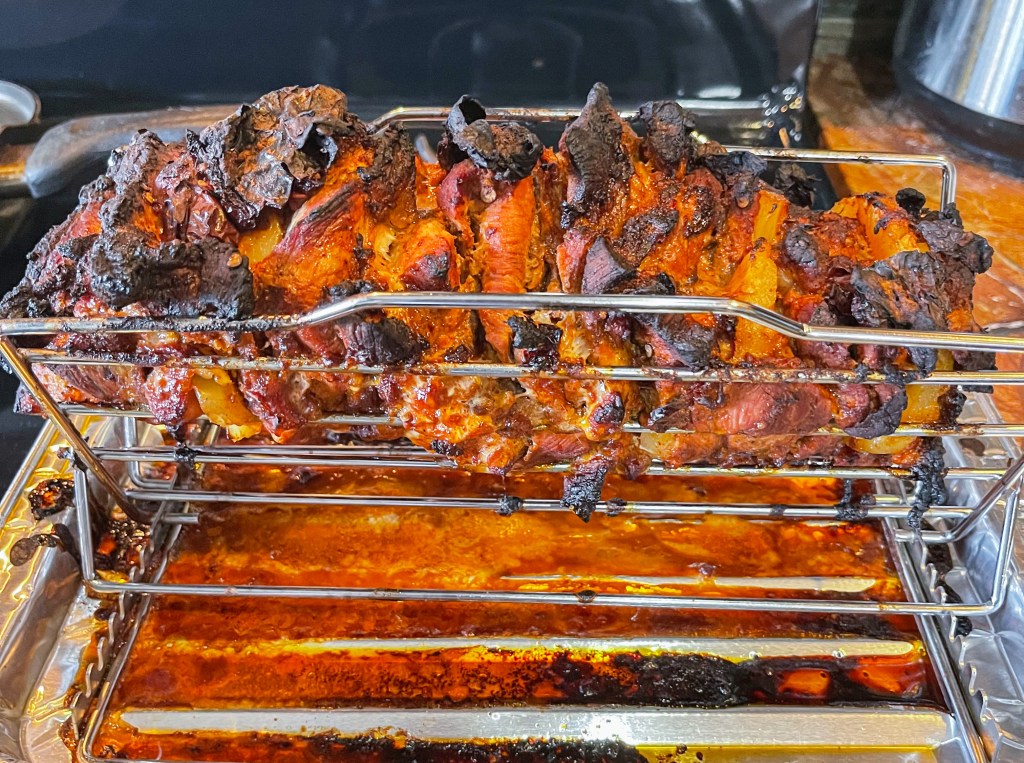
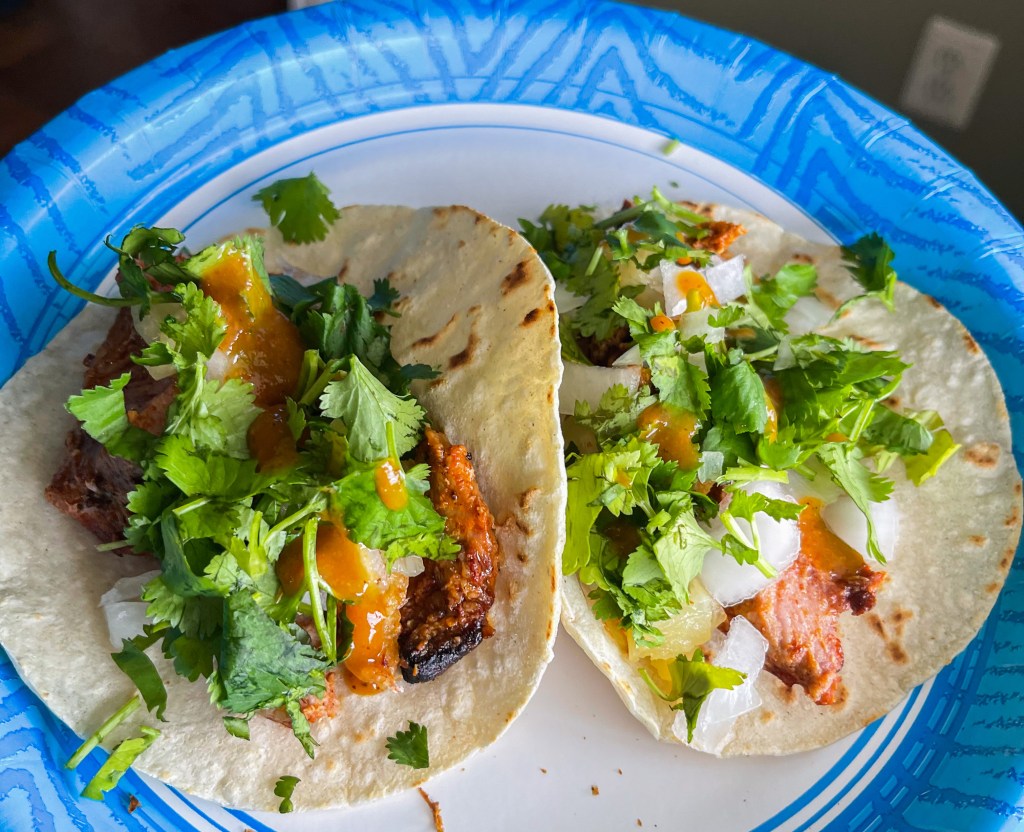
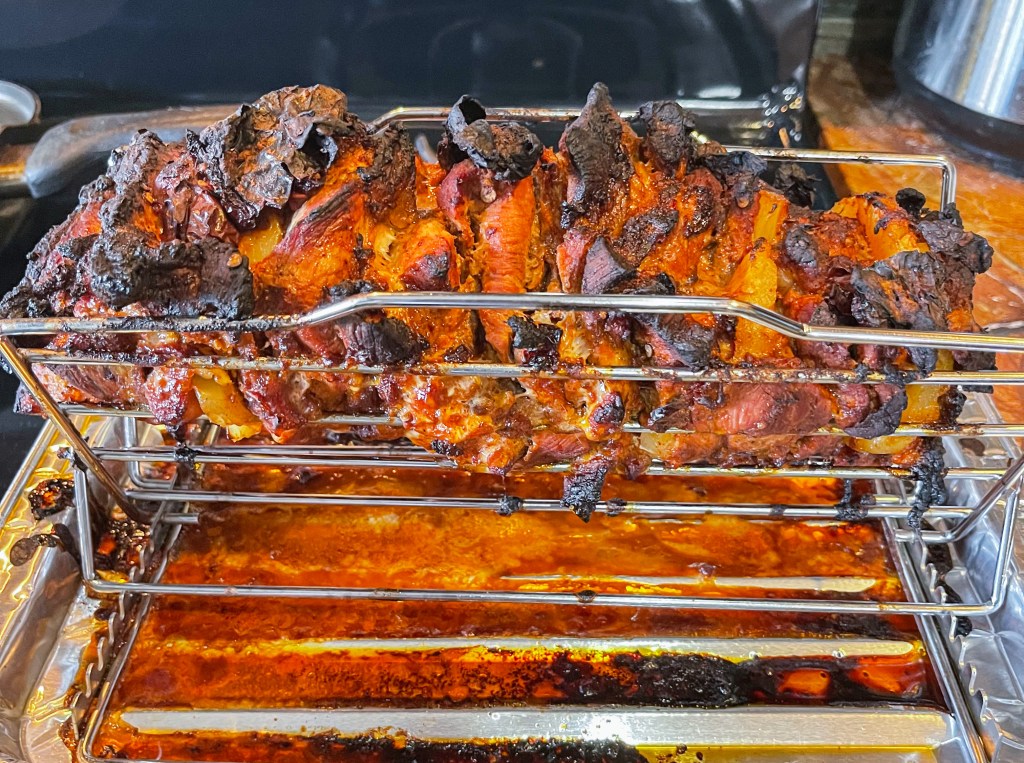
My boyfriend had some of the best and worst tacos he’s ever had when we visited Puerto Rico. When we came back to D.C., he was missing the al pastor ones that changed his life, so he decided to learn how to make his own at home. He slow roasted marinated pork shoulder stacked with pineapple, sliced it up, toasted corn tortillas, added cilantro and sliced onions, and managed to make some super delicious tacos. We live streamed the whole thing on his Twitch, so you can find that here, and follow the recipe below to make your own!
Top tips from me and Jose: 1) You can get most of these ingredients at any grocery store, but your best bet is to go to a Hispanic market to get quality tortillas, spices, and meat. You can do powdered Guajillo and Pasilla chiles for the marinade, but it’s better to buy dried chiles. If you do get the dried chiles, you’re going to want to boil 5 of each with 2 cups of water for 10 minutes until soft, then remove the stems and seeds, before pureeing them with the chipotle chiles, onions, pineapple juice, vinegar, garlic, and cumin in a food processor. Otherwise, follow the recipe below. 2) We eyed most of the measurements and it turned out perfect. These are estimations below, so do what you feel is best!
3) Allow your meat to marinate at least 2 hours, but the longer the better, so make it the night before if you can. 4) Buy an adjustable roast rack to hold up your stacked meat and pineapple in the oven, and to allow it to evenly cook.
5) Patience is key. Start this recipe at least 4 hours before you want to eat. 6) Warm your corn tortillas in a skillet to make sure they don’t fall apart, and because they taste better that way.
Time: From start to finish, this took us about 3.5 hours. This could easily make 18 tacos, if not more.
Ingredients 2.5 lbs pork shoulder, sliced into fillets big enough to stack on a skewer — 4 tbsp powdered Guajillo chile — 4 tbsp powdered Pasilla chile — 1 can of Goya chipotle chiles in adobo sauce — 2 tbsp minced garlic — 1 tbsp ground cumin — 1 tbsp salt — 2 tbsp Goya Adobo seasoning with pepper — 1/4 cup white vinegar — 2 cans pineapple rings, most for stacking, leftovers to dice and garnish tacos — 1-2 wooden skewers — adjustable roast rack — metal or aluminum pan — 18 corn tortillas — 1 bunch cilantro — 1/2 white onion, diced
Instructions:
1. Slice the meat into fillets about 1 inch thick. Add them to a dish or pan for marinating.
2. Add Guajillo chile, Pasilla chile, chipotle chiles in adobo sauce, minced garlic, ground cumin, salt, Adobo with pepper, and white vinegar to the pan with meat. Mix until thoroughly coated. Cover with foil and let marinate in fridge for 2-8 hours.
3. Preheat oven to 400 degrees F.
4. Remove meat and set up roasting pan. Hold the skewer up on a plate and start stacking the meat. About every third piece, add a pineapple ring. Repeat until all the meat is stacked. 5. Place the stacked meat sideways on the adjustable rack, which should be on top of a pan. Place in oven and bake for 1 hour and 20 minutes.
6. Before meat is done, slice onion and chop cilantro for toppings. Toast corn tortillas in a pan over medium-heat for a few seconds on each side.
7. Allow meat to rest for at least 5 minutes after removing from the oven. Slice however you’d like, but I recommend holding the skewer vertical over a plate and slicing from the top down like shawarma.
8. Build your tacos! Add meat, pineapple, onion, cilantro, and other optional toppings like hot sauce, on your warmed tortillas. Enjoy!
Learn more about the delicious mushrooms and fruits from the DMV!
Welcome to The Sunday Roast! Thank you for your patience as I took a break from this newsletter. Last month, when this was supposed to send, I was celebrating my birthday, and the subject I originally had lined up got too busy. Then, the subject below swooped in and saved the day. I saved this send until now to make sure I gave him a proper TSR, in addition to a proper social media break that I desperately needed. I’m feeling refreshed and ready to dive back in! I hope you enjoy the different format below.
This month: Technically, this would be this past month, but I really wanted to try pawpaws. I saw the regional fruit all over my Instagram as people were buying the fruit to enjoy during its super limited season. So I searched and found one company a friend had bought her pawpaws from. They were kind enough to deliver the pawpaws to me within a few days before I had to head out of town, and even agreed to an interview! And let me tell you, these things were amazing. I’m so thrilled to feature a local business owner and truly local fruit in this October edition.
MeetIulian.
Photo courtesy of Arcadia Venture
Iulian grew up in Northern Virginia and began his career taking culinary classes as part of his high school curriculum. While working at local restaurant Trummer’s on Main on his days off, he realized that cooking was his passion. He soon enrolled at the Culinary Institute of America in upstate New York, where he got the opportunity to work for four months at the acclaimed Noma restaurant in Copenhagen, Denmark. Iulian says he acquired an in-depth knowledge of indigenous ingredients and unique methods of food preparation at Noma, influencing his later passion of exploring local produce and foods.
During the last four months of his time at school, Iulian spent time at the Puglia Culinary Centre in southern Italy learning and preparing foods from every Italian region. He also undertook various educational trips throughout the Mediterranean to strengthen his culinary and foraging skills and worked at Ristorante Peppe Zullo, a biodynamic farm and restaurant in the mountains of Puglia. When he returned to D.C., he saw an opening in the market for local ingredients, and the rest is history.
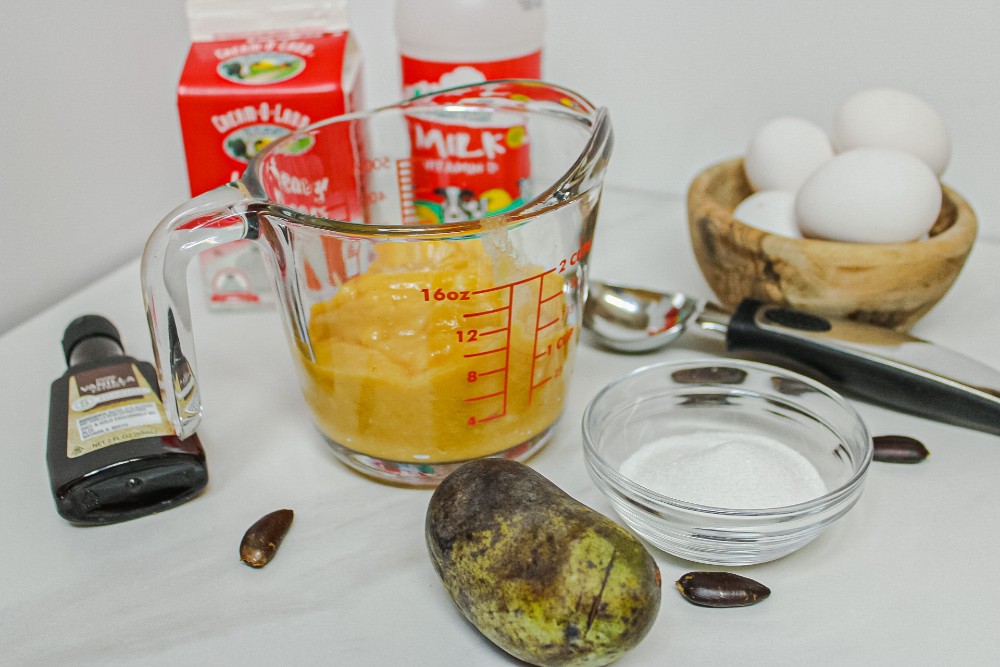
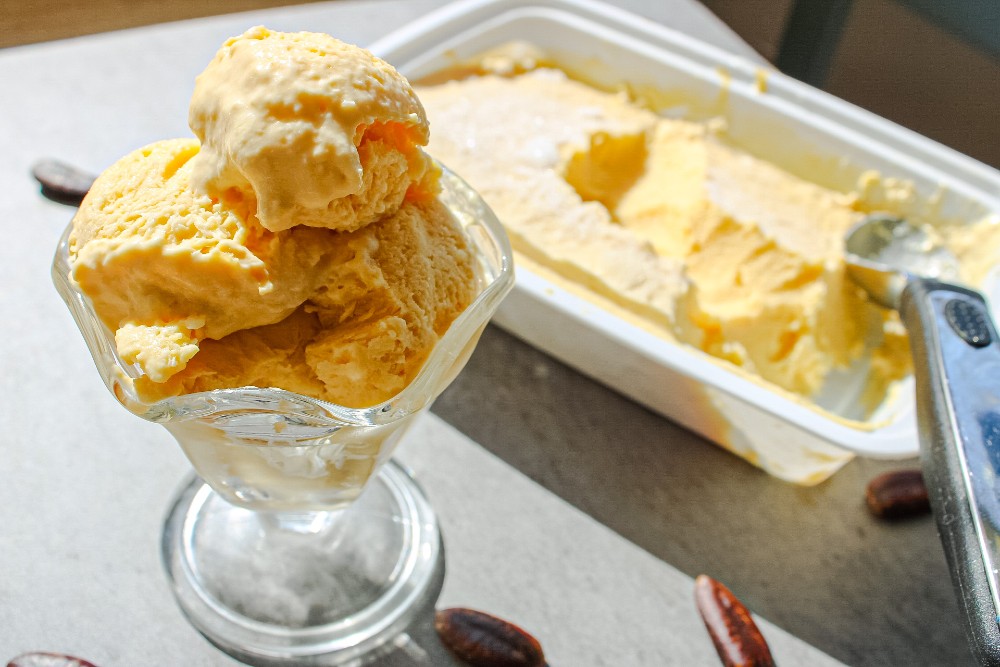
A view of the ingredients used to make pawpaw ice cream, including the bruised fruit in front.
Do you have any advice for anyone looking to get into foraging? Like, how do you determine the dangerous from harmless?
For anyone looking to get into foraging, find someone experienced in your region and start learning from them. Books are a good way to start acquiring knowledge but more importantly it’s the hands-on experience that will teach you about the land. Start slowly and see what particular things interest you, whether it’s mushrooms, medicinal plants, or wild fruits. Start observing and learning the seasons for each product you want to work with; it changes slightly each year and even more so now with the large weather swings from climate change. As for knowing edible from poisonous, don’t eat everything you see! Learn the major deadly plants and mushrooms. There are not many things that could kill you, but there ARE many things that will make you incredibly sick. If in doubt, err on the side of caution.
I see you originally set off for a career in cooking with your degree from the Culinary Institute and your position at District Winery. What made you decide to take the leap to a food business owner and open Arcadia Ventures?
I have been fascinated with wild food ever since my internship at Noma in Denmark. In Scandinavia it is a very commonplace thing; most families go out into the woods or beaches and pick wild food. In fact it is a constitutional right over there, the “right to roam”. I decided to quit my job at District Winery to focus on building a business around this because I saw a real lack of locally foraged food in restaurants. Besides the random mushrooms here and there from various mushroom pickers there was no actual business that focused on wild food in the DMV. There is such a bounty of products in the mid-Atlantic region, some native and some established over time as a result of trade and commerce over hundreds of years.
I know you supply ingredients for a lot of well-known restaurants in the area, what made you decide to also sell your product for delivery to home cooks? Do you aim to expand either of those parts of your business?
Well, necessity to be honest. In April of 2020 everything was shutting down. Restaurants were rapidly closing due to the pandemic and very limited to doing only basic food to survive. At that point the market for specialty ingredients practically vanished. It was also a time when everyone else was working from home and eager to start cooking. I used to do produce boxes with a mix of different vegetables, fruits, and mushrooms. The products were from a couple of farms I work with that specifically supplied only to restaurants and chefs: incredibly high quality and varieties of products not seen in grocery stores. Although they were really popular after a few months I stopped doing them because it took up so much time to package and deliver the boxes to each home. Now I still do some home deliveries of a la carte items, especially wild mushrooms. What I am hoping to start by the end of the year is to provide some products to local independent grocers and butchers.
Why were you enticed to come back to the DMV area for a career in food? Why establish Arcadia Ventures here?
I returned to the DMV after school because I wanted to find a high-paying chef job and just save up a lot of money by living at home with parents. After I decided to start Arcadia Venture it made sense to do it here because I understand the products that grow here and I already had some connections in the restaurant world. If I moved to another part of the country I would have had to start from scratch and had a much higher learning curve for starting a new business, especially a foraging business!
What’s your most popular product versus your favorite?
My most popular product is actually Paw Paws! Last year was a terrible paw paw year because a late frost killed off a lot of the blossoms. I had much more demand than I had supply. This year though it is much better and I can offer them to more people for them to try this unique fruit. My favorite item has to be Hen of the Woods mushrooms. They are also known as “maitake”. Although you can grow them, the wild variety is a lot stronger in flavor. It grows in large clusters that can weigh 20-30 lb even!
When it comes to pawpaws, how popular are they among your customers? Why did you decide to forage and sell them?
Paw paws are very popular. A lot of my restaurant customers eagerly await the season, which only lasts a few weeks, to stock up on it. What I really like is when a customer tries paw paws for the first time. A lot of times they never imagined that a “tropical” fruit grows in the wild here. I decided to forage and sell them because they show a particular time and place of where we are. The end of summer ripens the paw paws until they fall from the tree and the tropical aroma fills the air. They are something quite special.
Can you talk to me a little bit about pawpaws, like your knowledge of the fruit and what recommendations you usually give to customers for eating, storage, use, etc.?
Paw paws are the largest native fruit in North America. They grow east of the Mississippi and north up into Ontario. They are a very finnicky fruit and start to turn black when fully ripe (like bananas). If you want to save them for later you have to freeze the pulp. For cleaning them, take the skin off by hand in a small bowl, mash the pulp with your hands, and take out the seeds. Do not let the pulp sit in a container in the fridge. It will go bad very very quickly unless you freeze it. Afterwards you can use the pulp by thawing out as needed.
Paw paws are a difficult tree to grow for fruit. Although the trees themselves are easy to grow, they take 7 years to start producing flowers and around 3 more years after that to do fruit. If you plant just one tree you will never get fruits. There needs to be a lot of diversity for cross pollination. In the wild they usually grow in “colonies” where most trees are shoots of the parent tree, therefore genetically the same. Another tree from a different colony (like a seedling) has to be introduced for them to start making fruits. So imagine around 15 years from start to finish to get a productive group of trees!
What is your favorite way to eat or use pawpaw?
My favorite way to use paw paws is for ice cream. It really preserves as much of the flavor as possible and showcases the “custardy” texture of the paw paws.
Iulian sent me this recipe and recommended it! You essentially make a custard with mashed pawpaw and then freeze into an ice cream.
A note from me: I don’t have an ice cream maker so I ended up using the old fashion method of shaking the bagged custard in another bag filled with salt and ice. Then I froze it for the rest of the time. Still tastes delicious and creamy!
Processing…
Success! You're on the list.
Whoops! There was an error and we couldn't process your subscription. Please reload the page and try again.
Open the August edition for a recipe from a Best of D.C. finalist + Michelin Starred chef.
Welcome back to The Sunday Roast! I hope everyone is surviving this insane weather with heat waves one hour and downpour rain the next. I was on vacation in Virginia Beach last week so this month’s newsletter is delayed by a week so I could devote the proper time. I don’t have much more chatter to include here so let’s dive in!
This month: I reached out to a couple of my all-time favorite chefs that I admire so much on Instagram, and managed to line them both up for this month and the next. Now, I’ve got the story of a well-known chef, born and raised in the DMV, and a wildly popular recipe from their beloved pop-up restaurant. Scroll down!
Chef Marcelle has always loved food. They learned to love it and restaurants at a young age, and it was ingrained in who they are so early on. They say they were fortunate to grow up around a family full of fabulous home and professional cooks. Marcelle’s grandparents were an integral part of their early obsession with food, starting with when they would rather spend time with them in the kitchen than with other children. Marcelle says they find themself to this day recalling memories and making recipes based off of those memories.
Their parents also played an integral role. They owned small mom-and-pop pizza and sub shops in Maryland, so Marcelle started working at the shops when they were 10 years old. In their late teens, the only thing they really knew was a kitchen, so they set out on a career in food. Marcelle got a gig at their first service style restaurant at 17, and their understanding of the culinary world only broadened from there. They read, studied and worked nonstop to gain as much knowledge as possible.
They spent time in Spain, Puerto Rico and across the continental U.S., but after growing up in Silver Spring, the DMV has always remained home. In the late 2000s and early 2010s, the food scene in the DMV was rapidly expanding, meaning there was loads of opportunities to learn under chefs like Jose Andres and Bryan Moscatello, so it was an easy choice to stay. Since then, they’ve worked at several locally loved establishments, such as Maydan, Compass Rose and the Bluejacket Brewery, and even opened up their own concept, which I’ll touch on more below.
But first, more about Marcelle. On their social media, they’ve been open about their identity as a transgender person with Palestinian roots. Marcelle recently posted about the one-year anniversary of coming out on Instagram and of their transition journey. I asked what that journey has been like while working in the DMV culinary scene, and they said that they had a supportive, progressive support network in D.C. that welcomed them with “love and open arms.” And in the spirit of wanting to live their best authentic self, Marcelle embraced their Palestinian heritage to use food as a bridge to advocacy, even launching merchandise with proceeds going to organizations helping Palestinians in occupied territories.
“For us in the diaspora, specifically my generation, we are in a moment of reclamation of our pride, our roots, our fight. I’m just trying to do what I can with what I have for my people that are struggling in a capacity many people unfamiliar with the situation might not know about. I feel that it’s my responsibility to share what I know and help however I can,” Marcelle says.
Which brings us to, his Palestinian pop-up restaurant, Shababi …
Marcelle for five years led the kitchen at Bluejacket Brewery, a popular beer and bites outpost in Navy Yard, before heading the critically acclaimed Maydan and Compass Rose. No matter where Marcelle was lending their talents, they always made sure to make the food of their people and heritage. And they’re proud of the work they did there, including maintaining the existing Michelin Star at Maydan and earning another in 2020. Marcelle’s leadership and cooking was noticed around D.C., and eventually, at the end of 2020, they decided it was a natural progression at that point in their career to move onto the next opportunity: Shababi.
For Marcelle, 2020 was a real year of self-reflection, as many can relate. They found themself wanting to express their most authentic self and the things they wanted to pay the most honor and homage to. Their grandparents, who were in the 1948 Nakba, always spoke about Palestine, and it was the part of their heritage they always felt the most connected to.
At the same time, it was also a part of Marcelle that they were continually toning down professionally, so to be as authentic as possible, they knew they had to get over that hurdle and properly represent themself and their people. In comes the musakhan, a staple Palestinian slow-cooked chicken dish smothered in loads of seasonings, especially sumac. Muskhan seemed to Marcelle like the perfect way to be authentic because of how important it is to the Palestinian people as a comfort food.
They then started Shababi at the height of the pandemic, as they say, “when nothing seemed certain but the comfort of home.” It felt right to them to bring their idea to life when the focus could be on the flavors in the comfort of one’s home and the shared experience of a family meal. The pop-up currently operates weekends out of Roro’s Modern Lebanese restaurant in Alexandria, which Marcelle says allowed them to create Shababi with the sense of urgency that they felt it needed. The restaurant became the right space at the right time.
And so far, people have loved Shababi’s chicken! Marcelle says the reception for the musakhan has been overwhelmingly and so humbly incredible!
Shababi started as a pop-up in January, and off the bat the reception was so welcoming, so Marcelle knew they had to continue it. After eight months of neighborhood drop-offs, where one could organize several orders to be picked up in a place other than the restaurant, and rotating menu specials, like vegan arayes (a typically meat-stuffed pita), Shababi is standing strong.
Eight months later, it’s a 2021 RAMMYS finalist for outstanding ghost kitchen or pop-up concept and has been nominated for four categories in Washington City Paper’s Best of DC for 2021.
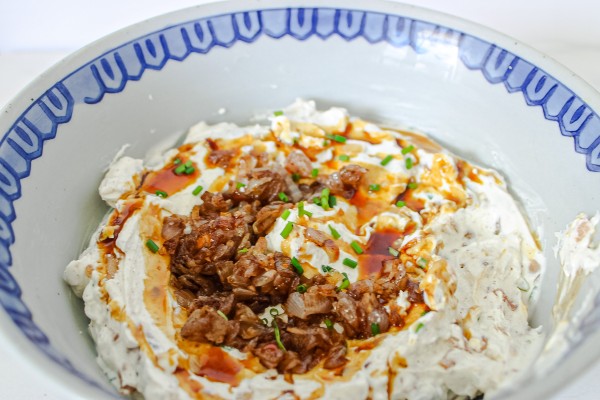
One of the most popular menu items surprisingly has been one of the sides: the French onion labneh. The ultra-strained, ultra-thick Greek yogurt-like spread is tangy and perfect for dips, os that’s exactly what Marcelle’s family did. They say the family would eat labneh piled high with onions and topped in pomegranate molasses.
Marcelle says, “thinking of those flavors and a mutual love for French Onion dip, it seemed like a natural marriage of flavors.” They love to take inspiration in their recipe creation from their childhood and the things they have grown to love. The labneh is still on the menu, because when Marcelle once tried to give it a break, fans of Shababi spoke up about missing it, so it’s been on the menu ever since. And now, you can make your own version at home.
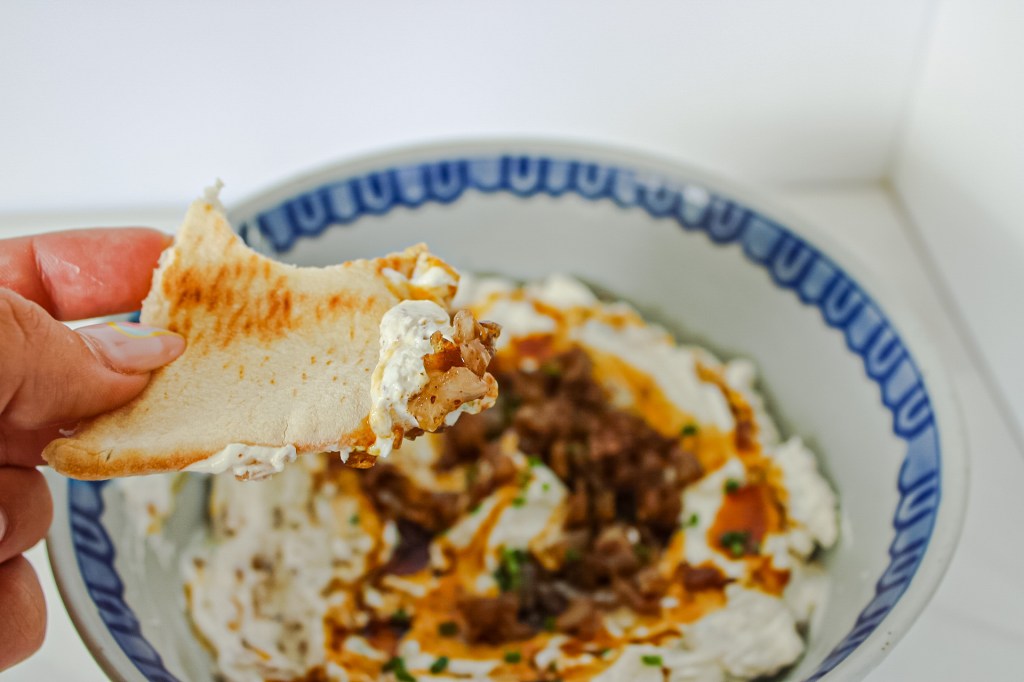
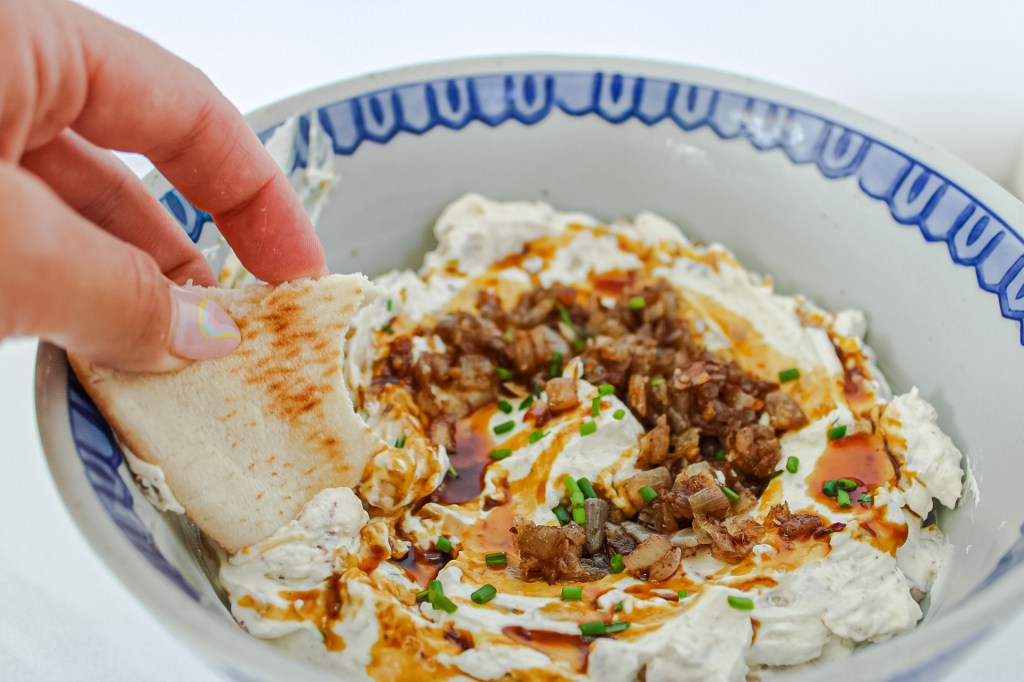
The tang from the labneh with the earthy, salty flavor of the onions, and the sweet cut of that pomegranate molasses truly makes one of the best dips I’ve had. This is like that Helluva Good French onion dip but fancy, homemade and so much better.
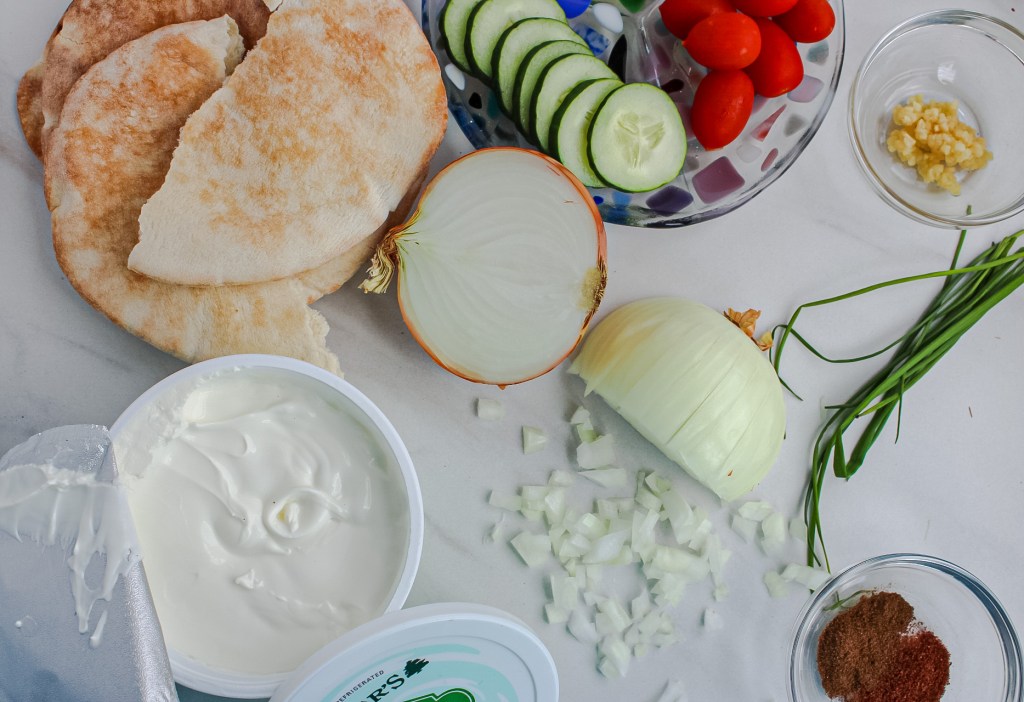
Top tips from me: 1) You can head to any of the Whole Foods to get the ingredients you need, though I couldn’t find the nigella seeds at mine. Otherwise, you can check out one of the several Arab grocers in the DMV, like the Mediterranean Way Gourmet Market or Shemali’s Market. 2) Try to grab the Karoum brand labneh, or ones that come in a tub like sour cream, since according to Marcelle, they aren’t as thick as the Turkish style ones that are in what look like cream cheese containers. 3) If you can’t find chives, one can use scallions, just a little less in proportion. 4) A note from Chef Marcelle on optional ingredients: “The sumac, pomegranate molasses, nigella seeds, one may not have in their regular pantry, but they are great to have and cross utilize in other recipes if you choose to get them for this recipe. Sumac is a great spice that we use for acidity, that can enhance any salad or be used in any rub. Pomegranate molasses can be substituted for balsamic, and brings an awesome tangy touch in marinades and dressings. Nigella seeds bring a great oniony crunch as a finisher on any dip, and I actually love adding the seed in baked goods too!” 5) When cooking the garlic and onions, keep a close eye on them and stir frequently! You may need a few extra minutes to really caramelize those onions if your stove is as old as mine. I’d say it took me an extra 5 minutes or so to get them properly browned. 6) I didn’t try the dip without Marcelle’s suggested toppings, but I do think the pomegranate molasses is definitely a must-add. So good! 7) When serving, swirl a donut-shaped divot in the dip and then add your extra onions and molasses in there. 8) Serve with fresh warm pita, pita chips, vegetable crudite, potato chips, or as a smear on your bagel, whatever you want, but as Marcelle says, we enjoy it as a part of every meal!
Time: This took me max 45 minutes start to finish, accounting for the 30 minutes of refrigeration. This could easily serve like 10 people paired with dipping vessels.
Ingredients 1lb Labneh — 2 Tbsp Chives, chopped — ½ tsp Onion Powder — ½ tsp Garlic Powder — 1 medium Sweet or Spanish Onion, small diced — 2 cloves Garlic, minced — 1 tsp Sumac (optional) — ¼ tsp Allspice, ground (optional) — Kosher Salt — Olive Oil — Toppings: pomegranate molasses, nigella seeds, cooked onions and garlic, chopped chives or scallions
Instructions:
1. In a medium pan, over medium heat, add 1 Tbsp olive oil. Add the diced onions, cook on medium heat for about 3-5 minutes, stirring frequently, until they start to lightly brown, add a pinch of salt.
2. Lower heat, add minced garlic, add ½ tsp more olive oil.
3. Add the sumac and allspice, and another pinch of salt. Cook for an additional 5-8 minutes or until they appear lightly brown and caramelized.
4. Set in a container (no lid) and allow to cool completely.
5. Place the labneh in a medium bowl, whisk until it starts to loosen, the more you whisk labneh, the silkier it becomes. This will take about 2 minutes.
6. Fold the chives, onion powder, and garlic powder into the labneh.
7. Reserve 2 Tbsp of the cooked onion and garlic mixture to use as topping. Place the remainder and fold into the labneh, with all of the residual bits and oil.
8. Refrigerate for at least 30 minutes before serving. It can be refrigerated for up to 5 days.
9. When serving, we like to top it with a swirl of pomegranate molasses, ½ tsp of nigella seeds, the caramelized onions & garlic, and chopped scallions or chives. You can use all or any combination of these items!
10. Serve with fresh warm pita, pita chips, vegetable crudite, potato chips, or as a smear on your bagel — we enjoy it as a part of every meal!
A Hawaiian recipe from a local business owner’s waiting inside the July edition of TSR…
Welcome back to The Sunday Roast! Thanks for being a loyal reader. I’ve got another awesome local business owner featured this month, and an extra special gift card giveaway to encourage y’all to go out and support her. I’ll be unveiling the gift card giveaway on my Instagram around the same time this newsletter drops, so make sure you go follow @thesundayroastnews to enter to win a $25 gift card to Abunai! It ends on Friday, July 30th!
This month: During AAPI Hertiage Month in May, I made an effort to reach out to several AAPI-owned businesses to feature their amazing food as much as I could, and one was Abunai in downtown D.C. We had some scheduling issues as Akina, the owner, was busy at the time, but we were finally able to catch up this month. This feature lined up perfectly with my Instagram account passing the 500-follower mark, so I decided to celebrate that with a gift card giveaway as well. Make sure you take the time to read and test out the perfect lunch recipe.
Akina has been spreading the love for Hawaiian food and culture at her poke shop downtown for over four years now. Long considered one of the best poke shops in D.C., Abunai also serves up other delicious Hawaiian classics, like mochiko chicken, Kahlua pig nachos and, of course, spam musubi. She’s even operated her food trucks and opened some locations in Philly, bringing a taste of Hawaii everywhere.
Akina originally hails from Honululu — she even still has the 808 area code. She moved to the East Coast many years ago and immediately was entranced with the idea of opening up a food truck. She landed in D.C. after a friend living there suggested she join her, and despite only visiting when she was little and not researching the area much, she made the leap. Then, after a quick turnaround for the food truck application process (literally a day), she opened up the Abunai food truck that she parked downtown for the office lunch crowd. After parking in front of her current storefront for a while, the owner of the building, who frequented the truck for lunch, approached Akina to ask if she would be interested in leasing the storefront. In April 2017, the L St. location opened up for business.
A year later, she expanded to The Bourse, a Philadelphia food hall, where other D.C.-based businesses are as well, including Prescription Chicken and TaKorean. She used to go back and forth between the cities but doesn’t anymore since she has staff there to maintain the location. She’s kept her downtown location, but definitely is biased towards food trucks being a bit easier to maintain with low-cost, hands-on work.
All the while, Akina’s been killing it on the business side as a single mother. Her son just turned four years old after spending the last year or so always with Akina due to the pandemic shutting down many school and childcare options. Akina said she set up a table in the corner with books and other activities to keep him occupied while she maintained the restaurant. Now that D.C. is fully reopened, she’s looking to hire more staff to keep up with the demand for her food since pre-Covid, with school open and a full staff, it was easier to deal with. Some fellow owners in the industry have asked if she has staffers to spare, though she hasn’t had any yet.
Keep scrolling for more on Akina’s mission to bring Hawaiian food to the District.
The story behind her recipe.
Akina’s whole family is still in Hawaii, but she’s here bringing the essence of D.C. When she first launched Abunai in food truck form, she noticed a lack of Hawaiian cuisine in the District, so she thought she’d try bringing it here since she cooked all the time at home.
She wanted to share her culture and food with the DMV community and see what they think. So far, they love it! Akina noticed that when she sold poke as a special on the truck, it was always really popular, despite her offering a variety of Hawaiian food. The downtown crowd tends to prefer healthier, fast casual options, just like poke. So Abunai offering poke downtown made sense. But don’t worry, the shop is still different and authentic compared to some of the other shops, that have opened since during the poke craze but not drawn attention away from Abunai.
The menu was curated of recipes that Akina and her family cook at home, so you know you’re getting the real deal. Every year, Akina will upgrade or slightly change the recipes to make sure the food is always the best.
She may change the sauce or do the marinade slightly differently for the Spam or chicken. She changed her Abunai sauce during the pandemic slightly, and even though nobody else can tell, she continues to tweak her recipes. That’s what makes her spam musubi so popular, which I begged to highlight here in the newsletter. It’s one of the most popular menu items, and one of Akina’s favorite as well. She says because it can be eaten as a snack or meal, the shop goes through a lot of Spam.
But due to the location of Abunai, it was devastated when the pandemic forced offices to close, leaving downtown D.C. completely dead. Akina unfortunately had to cut about 90 percent of her staff since her sales dropped severely. She transitioned to mostly online delivery for a while, but the radius is not that far since there aren’t many residential areas near the storefront, so that wasn’t booming as well. Then, Abunai adjusted mostly to takeout quite easily since its fast casual environment made the staff used to workers grabbing lunch to go.
Some tuned into the D.C. Instagram community may have heard about Abunai after a local food blogger posted negative stories about the poke shop. I won’t blast that person here, but suffice to say that they didn’t appreciate their pick-up experience, but then things escalated when they asked about compensation and posted stories about the experience. Akina, of course, responded to the situation to set the record straight.
She says she’s a very upfront, honest person, so if someone has an issue, she’s happy to fix it, but if it’s a lie, she’s correct them. Some may not realize Akina is at the shop all the time from open to close, overseeing everything to make sure it’s running smoothly, so she knows how situations play out. But after that snafu on social media, the community showed up and the shop was very busy. So busy that we had to delay any interview! Akina wasn’t expecting the outpouring of support, and since Abunai was understaffed, things were crazy. A couple of other foodie influencers, like Hypefoodies, were kind enough to offer marketing services around the same time as well.
Akina said she also saw increased support from the community the following month during AAPI Heritage month. She saw lots of new faces that she has seen come back already.
While it was exciting to get more loyal customers, the recent reopening of the city has been daunting. Abunai has seen busy times in the last two months, even before the city reopened in June, and the understaffing issue was seriously highlighted by that. Akina said they’re all just trying their best everyday, and she cancelled some catering bookings to help focus on the shop. But if you’re looking to support the shop and a local business owner, head over to grab lunch, try out this recipe, and enter to win the gift card to Abunai.
Make the most delicious and easiest lunch with the recipe.
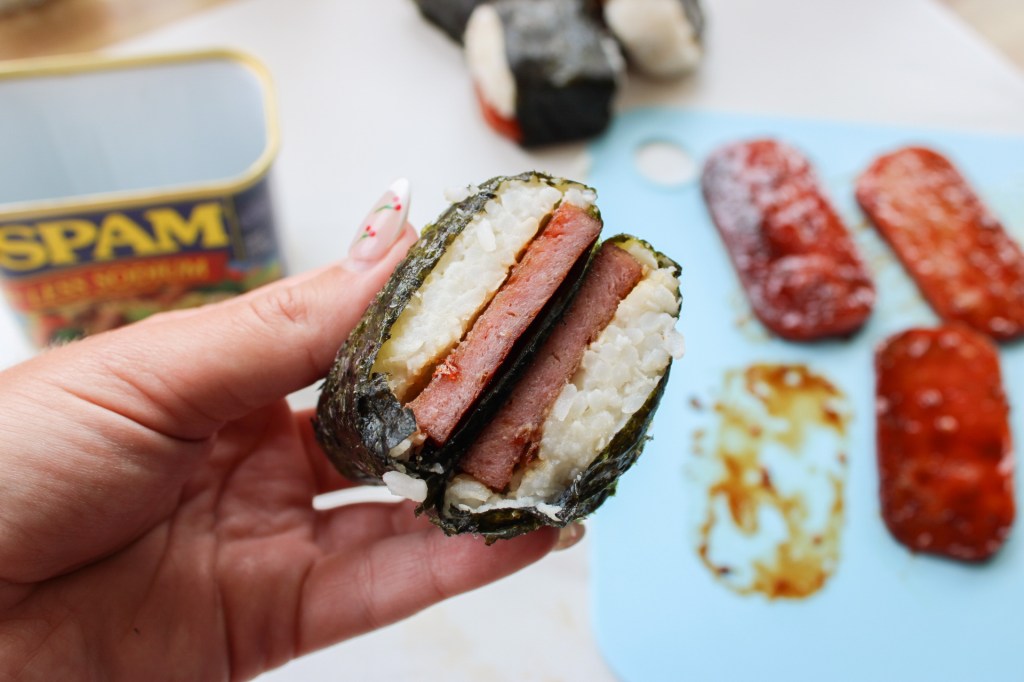
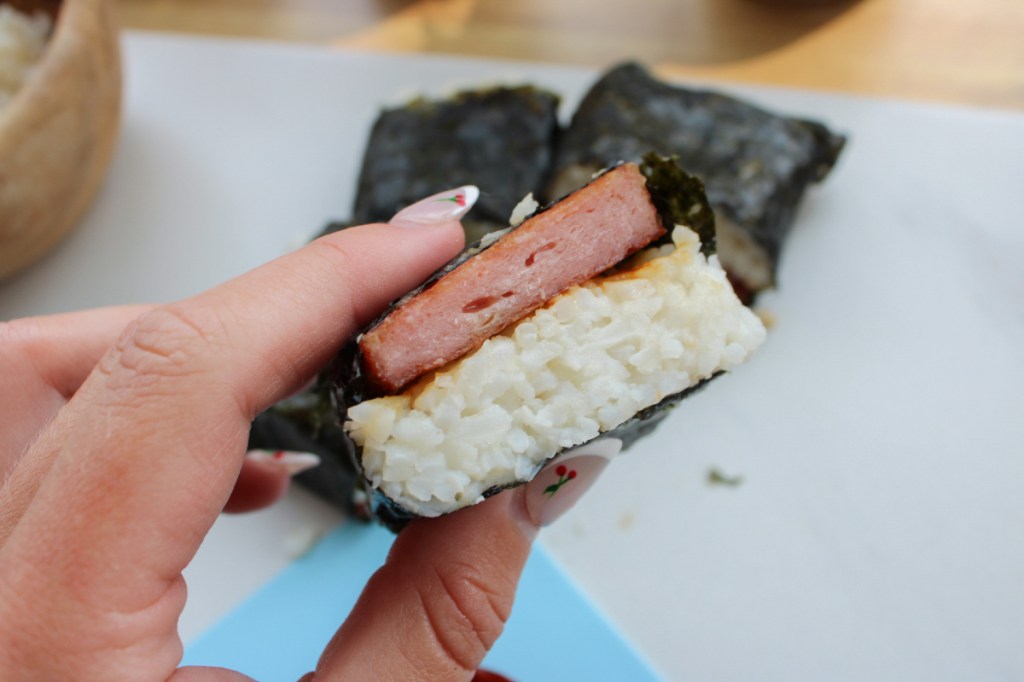
The sweet and salty spam was so delicious with the soft, sticky rice and the crispy seaweed. I know my wrapping skills aren’t nearly as good as Akina’s, but I can see why this flavor combination is so popular!
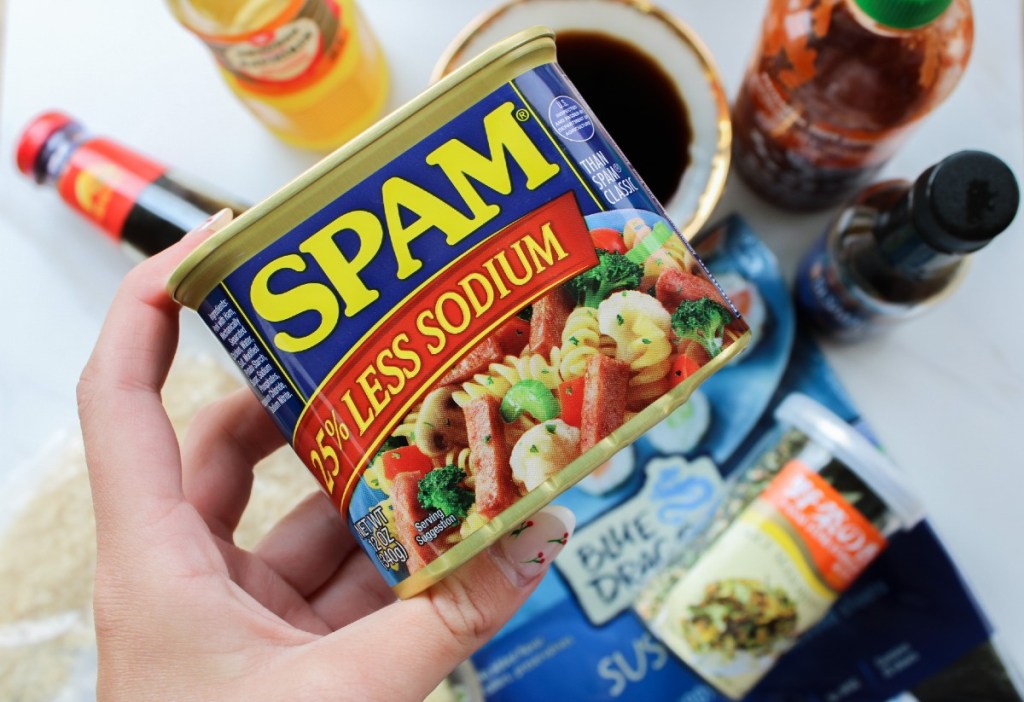
Top tips from me: 1) Most grocery stores will carry the ingredients you need, but if it’s a smaller store, head to a store like Hana or Rice Market to find quality sushi rice, furikake and sushi nori. While you’re there, maybe see if you can find the mold (or on Amazon). 2) Akina sent photos of her using low sodium Spam so I followed in her footsteps! Feel free to use the regular kind, though. 3) The Spam can works with a bit of saran wrap to help pull the rice out, but I imagine you can get a tighter sushi wrap and way more rice in there if you use a proper mold. 4) I recently ran out of sushi rice and couldn’t get more in time, so I used a bunch of online advice to make my plain white rice more sticky. I added extra tablespoons of water to steam it longer, letting it sit on the stove on low for another 20 minutes, then added in about a tbsp of rice vinegar. 5) I definitely did not make enough rice though, which is why my musubi looks way thinner than the gorgeous photos on Abunai’s social media. Make sure you make enough rice. In fact, make too much rice. You can never have enough. 6) Make sure you pan fry the Spam before adding the sauce! Get it nice and crispy, but not dry. 7) Give the sauce a good stir before adding it to the pan because the sugar didn’t fully dissolve for me. Also make sure you get that garlic and ginger onto the Spam. 8) You’ll like find sushi nori sheets that are too long, so just cut them in half. Nice and simple. 9) Wrap your musubi as tightly as possible, but don’t get discouraged by it not looking perfect. It’ll still taste amazing (I promise). 10) Don’t forget the furikake on top. I did before I took photos, but added it shortly after, I swear.
Time: This took me about an hour start to finish with my photo and video pausing. When making this for yourself for lunch, depending on your sushi-wrapping skills, it will likely take 30 minutes. This could easily be a meal for four, if each has four musubi.
Ingredients 1 can reduced sodium Spam — 4 cups sushi rice or white rice (see tip for how to make sticky) — 1 cup soy sauce — 1 cup granulated sugar — 1 tsp chili paste — 1 tsp oyster sauce — 1 tbsp sesame oil — 1 tbsp mirin, — 1 tbsp minced ginger — 1 tbsp minced garlic — 4 full-sized sushi nori sheets (8 when cut in half) — furikake
Instructions:
1. Take Spam out of can and cut into 8 even slices.
2. Meanwhile, cook your sushi rice. Once cooled down to room temperature, mold rice into musubi mold or spam can wrapped in saran wrap. Make sure the rice mold is several inches thick.
3. Combine soy sauce, sugar, chili paste, oyster sauce, sesame oil, mirin, minced garlic and ginger in a bowl to create Abunai sauce. Set aside to add to Spam slices later.
4. Pan fry Spam slices in skillet with a little oil, until golden brown on both side.
5. Once both sides are seared, add a splash of Abunai sauce (about 1 tbsp) on one side then flip to sear with the sauce for a few minutes. Repeat on the other side. 6. Remove spam from the pan and assemble your sushi-making station. Cut sushi nori sheets into the length of the spam slices.
7. Place spam on sushi nori sheet about 2 inches up from the bottom. Place rice mold on top.
8. Wrap the nori sheet around spam and rice mold as tightly as you can.
9. Cut Musubi in half. Sprinkle furikake on top and splash with extra sauce. Enjoy!
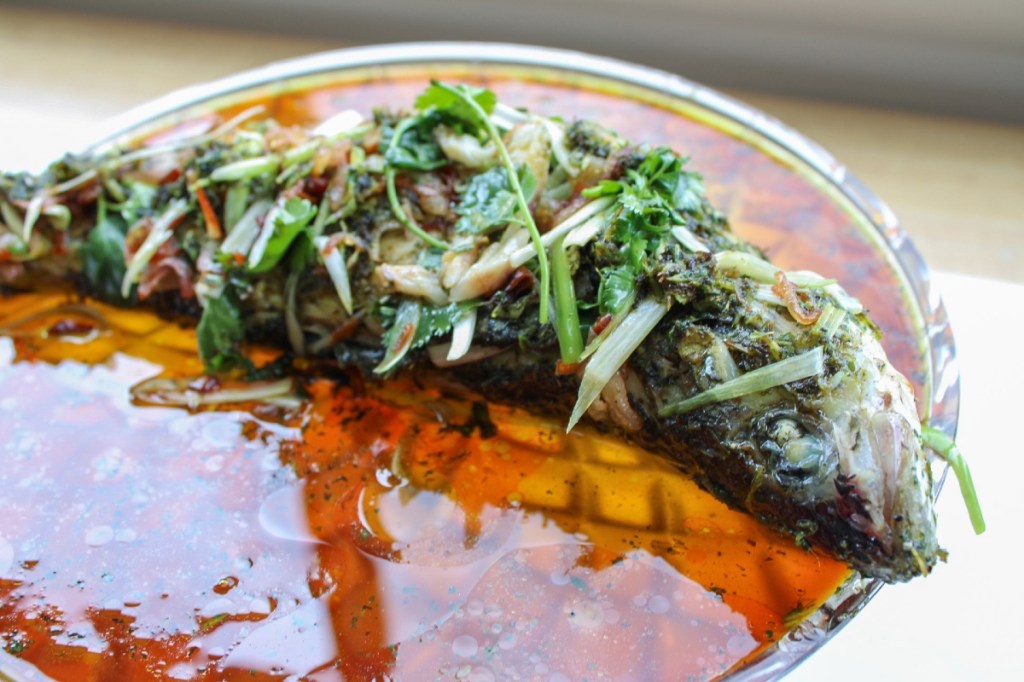
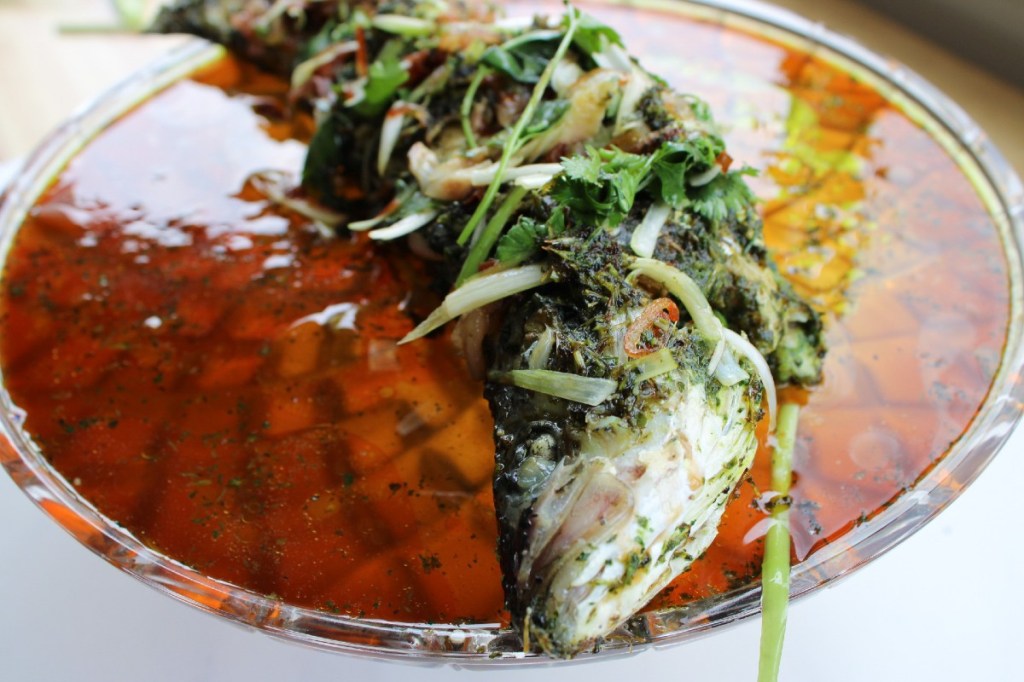
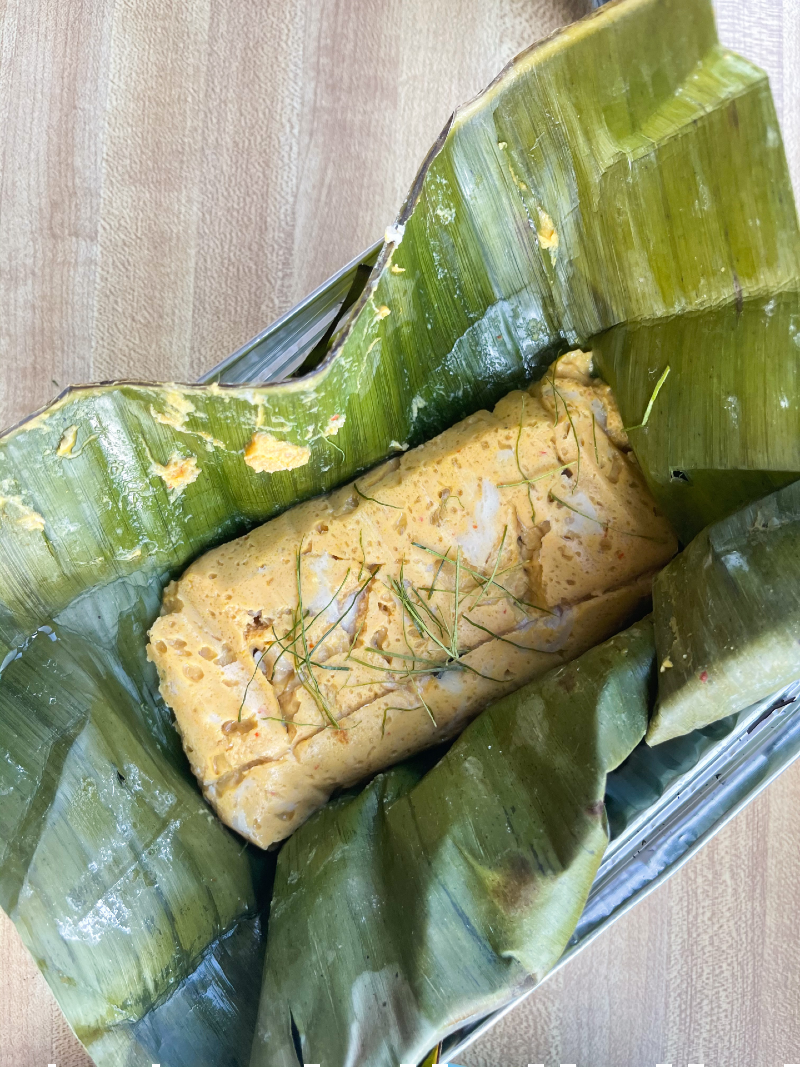
The flavor of the paste combined with the fresh, crunchy toppings and sweet sauce was complex yet very light. The fish was fall-off-the-bone tender and overall, my taste tester says this was the perfect filling summer meal. Plus, it was simple to make!
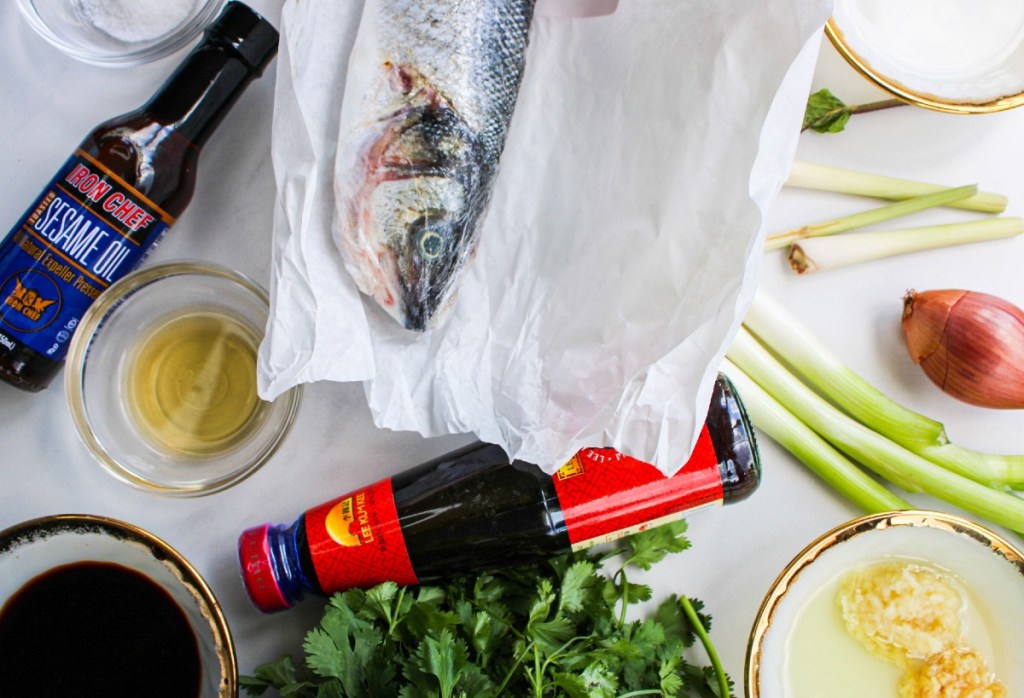
Top tips from me: 1) First and foremost, the most important thing is getting the freshest fish possible. I was lucky and was gifted this beautiful bronzini, already scaled and gutted, from the Lucky Danger team themselves. I would recommend checking out your local fish market, like the Wharf’s Municipal Fish Market. The team’s work to clean the fish did save me a lot of time (and another bloopers reel), so maybe splurge for the cleaning service offered at the Wharf. 2) If you need to clean the fish yourself and have not done so before, make sure you find a video or guide easy for you to follow and stick to it. This one gave me a clue on what that process looks like. 3) You can buy fried shallots pre-made but I had a shallot in so I decided to make them myself. I followed this Epicurious recipe and they came out deliciously crispy. 4) If your food processor is a bit off-peak like mine, add a drizzle more oil until it does form more of a paste than just a rough pesto. 5) Make sure to add enough oil to the pan and cooking spray on the fish to avoid the skin sticking and getting ripped off. I added quite bit and it still ripped off when flipping and such, so just be extra extra careful. 6) Some of the filling will fall out when cooking the fish but don’t worry about that. 7) Make sure you vaguely measure your largest frying pan before transferring the fish to it. I made the mistake of not doing that, which led to my fish forming a crescent shape as I tried to force it to fit the pan. 8) Be careful when you pour the remaining oil onto the fish before serving. It will likely splatter a bit and will still be hot!
Time: Overall, this took me about an hour and a half start to finish, keeping in mind that I did stop to take photos. If you’re cooking this like a normal person and the fish is already cleaned, then this would definitely take you under an hour, if not 30 minutes with pre-made shallots, too. This could easily be a meal for one or two or three. Depends on how hungry you all are!
Ingredients 1 bronzini, scaled, gutted and rinsed — 1 stalk lemongrass, crushed and chopped — 1 bunch cilantro — 4 cloves garlic — 1 tbsp ginger rough chopped — 4 tbsp grapeseed or canola oil, half for filling and half for frying — 2 tbsp fried shallots — 2 stalks scallions, julienne — 4 mint leaves, chiffonade cut — 1 tsp + 1 tbsp rice vinegar — 1 tsp sesame oil — 2 tbsp oyster sauce — 1/4 cup soy sauce — 1/4 cup water — 1 tbsp sugar
Instructions:
1. Make sure the fish’s belly is open after gutting. Make 3 diagonal cuts into the fish on each side of the fish.
Season lightly with salt and pepper on inside and outside of fish. Set aside for now.
2. Place lemongrass, 1/2 of the bunch of cilantro, garlic, ginger and 2 tbsp of the oil in a food processor and pulse until it forms a paste.
3. Gently open up the the belly of the fish and stuff the paste in, filling it up. Set the stuffed fish aside.
4. Fry your shallots, if needed. Slice one shallot thin. Use a small sauce pan and heat 1 cup of canola oil over high heat until 275 degrees. Fry the shallots for about 8 minutes until golden. Remove the shallots with a slotted spoon and place them on a plate covered in a paper towel. Increase the heat until oil is 350 degrees. Set up a heat proof bowl with a sieve over the top. Add the shallots back in and fry for a few seconds until crispy and browned. Pour the oil and shallots over the sieve into the bowl.
5. Mix the shallots, scallions, mint leaves, 1 tsp of rice vinegar and sesame owl in a bowl, and season lightly with salt and pepper. Continue to toss until leaves wilt slightly. Set aside for toppings.
6. Add 1 tbsp rice vinegar, oyster sauce, soy sauce, water and sugar to a small saucepan. Heat sauce until sugar dissolves and set aside.
7. Lightly spray fish on both sides with nonstick cooking spray.
8. Heat large non-stick pan on high heat. Pour 2 tbsp cooking oil into pan, and place fish carefully into pan.
9. Lower heat to medium and cook for 4 minutes. Carefully flip fish onto other side and cook for an additional 4 minutes.
10. Remove fish and place on serving plate. Pour sauce over fish and top with toppings.
11. Reheat oil that is left over in nonstick pan till about smoking. Pour oil over toppings.
Open here for a recipe curated just for The Sunday Roast News June edition by a local celebrity chef!
Welcome back to The Sunday Roast! I am so very excited for this edition. I know I say that every month, but this is a chef I’ve admired in the D.C. food scene for a while, and he was so incredibly generous with this time to help create this final product. I was a bit starstruck when speaking to him, so if you recognize his name or places like Emilie’s, American Son and Prather’s on the Alley, then you’ll really enjoy this, too!
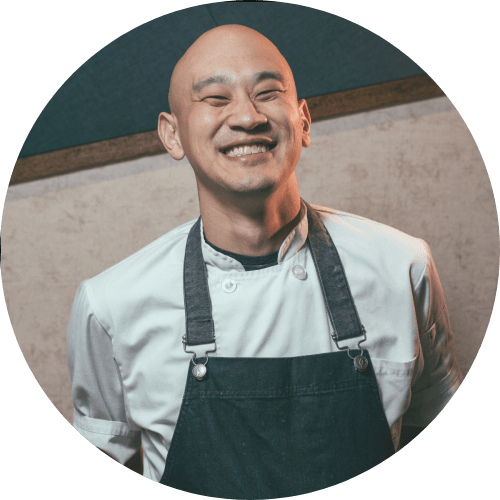
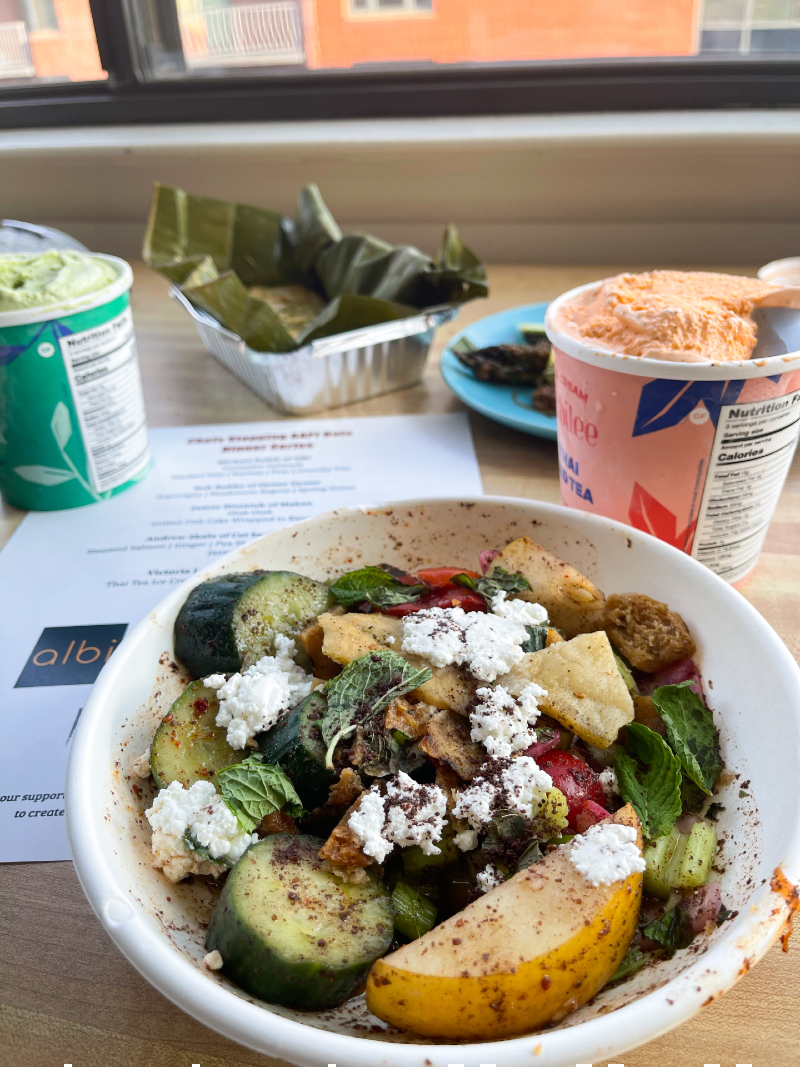
This month: As you may recall, my last edition was a special one to highlight a local-based national campaign during Asian American and Pacific Islander Heritage Month. I was lucky enough to snag a ticket to one of the last Chefs Stopping AAPI Hate dinners and an interview with one of the co-founders, Chef Kevin Tien. After highlighting the newsletter on social media, I managed to connect with the other co-founder, Chef Tim Ma! And while this is the June edition, it will be a bit different because Tim created a recipe especially for my lovely Sunday Roast audience! Make sure you take the time to read this incredible edition and test out the delicious recipe.
Tim Ma is a jack of all trades. He’s a former engineer, a trained chef, a restaurant owner, an operations manager, a chef consultant, a food and beverage entrepreneur and the co-founder of a national charity campaign. He’s always busy cooking up something innovative or groundbreaking in the D.C. food scene, so when he finally had a chance to breathe last Friday after winding down a month-long national program, I grabbed a half hour of his time to talk about his busy life as a well-known chef in the DMV.
Tim has called the DMV home for about 30 years now. He grew up in a family of restauranteurs in Northern Virginia, but his family pushed him towards an engineering career, and he originally only say food as sustenance. So he set off on a 12-year career after earning a bachelor’s degree from the Georgia Institute of Technology and a master’s degree from Johns Hopkins University. Around age 26, Tim decided to he wanted pursue opening a restaurant and then at age 30, he did it. He quit his job and went to culinary school at the International Culinary Center in New York City, where he learned the classic French style of cooking. His original intent was just to gain a fluency in that professional environment and not become chef, since he didn’t know how to properly hold a knife at 30, but he got really into the technical part of cooking, and ended up during an externship up at 2-Michelin Star Momofuku Ko, and cooking at the highly regarded Momofuku Ssam.
Then, in a brief foray to St. Thomas in the U.S. Virgin Islands to cook and formulate the plan for a restaurant, Tim returned to Virginia in 2009 to purchase a restaurant on Craigslist with his last remaining credit card. His friends and family helps make his dream come true, and even helped remodel it, before opening as Maple Ave Restaurant in 2009. Since then, Maple Ave was ranked the #1 restaurant in NoVa and he has helped launch several more critically acclaimed restaurants, including: Water & Well, the American sister restaurant to Maple Ave; Chase the Submarine, a craft sandwich shop; American Son, the Bib Gourmand restaurant at Eaton DC featuring American immigrant cuisines; Kyirisan, a Chinese-French concept that also earned a Michelin Guide Bib Gourmand; and now, his Chinese-American take-out pop-up, Lucky Danger.
Before Lucky Danger launched, Tim took over as executive chef of Prather’s on the Alley in Mount Vernon Triangle in November of 2019 after they asked for a recommendation for a chef and he suggested the best: himself. At the same time, Tim signed on as culinary director for Laoban Dumplings, a local company offering fresh frozen dumplings, and his family was honored by the Smithsonian Museum of American History with an induction of family heirlooms from the history of their restaurants. It was a busy time for him, but almost 50 members of his family came from around the world to celebrate. He says that at that time, the sense of family and the mark you leave was overwhelming. He had always done French cuisine in difference capacities, mostly with Asian accents, because it was what he was trained in and what his love for food and cooking grew from.
In that moment, and partially as a result of the pandemic when everybody stopped and slowed down, Tim thought, “Why is Chinese cuisine not strong enough to stand on its own?” He knew that Chinese food in America was part of the cultural fabric since there was not a town in the country without a takeout place, but there was still a perception that it was cheap and the tendency for it to be marginalized or made fun of. Tim then realized he should highlight that cuisine in its purest form, with the Chinese American dishes everybody loves with a few actual Chinese twist here and there, so that was the beginning of Lucky Danger in the Prather’s on the Alley space.
Keep scrolling for more on Chefs Stopping AAPI Hate + Tim’s recipe.
The story behind his recipe.
While the Lucky Danger concept at first was meant to be just like Chinese takeout where a customer can call in and pick up dinner minutes later, and Tim kept his name quiet in an effort to keep that mission central to the concept, eventually, the secret got out and led to 6 months of sold-out pick-up times. They were originally making a new dish every 7 seconds because of how many orders they received, which is why Lucky Danger switched to a pre-order system.
Tim says that while that does help him and his co-founder Andrew Chiou know how much they need to cook that evening before they even open, it’s not the original concept of an “accessible, egoless venture” they had in mind, so they’re making operations changes over the coming months to keep up with demand. Tim says the concept is built for massive growth, like Panda Express type growth, so they should have no problem expanding, which is what they plan to do with a new location in Arlington opening by the end of the month and more to follow.
The most popular dishes at Lucky Danger are, of course, Kung Pao chicken and orange beef, but the dumplings fight for that number one spot, too. Tim’s happy that those dishes are so popular because they are very classic Chinese-American dishes.
But still, his creativity is shown at the pop-up in the non-top sellers at Lucky Danger. He says that on the back end, they experiment and try to add more Chinese dishes to include a Chinese narrative, even though Chinese and Chinese American restaurants are two very different things. At Lucky Danger, though, you can get your Kung Pao chicken and your pork belly with mustard greens.
But anyways, on to the recipe. When I spoke to Tim on the phone, you could just hear in his tone how driven, ambitious and kind he is. I described the concept of my newsletter to him and despite his uber busy schedule, he immediately offered to sift through his archives and create one specially for me.
I am still a bit in awe of his talent and giving nature, so when he came back with a recipe that was unique and delicious while still staying fairly simple, I was ecstatic. Tim says that for most food interviews, he typically offers to cook up a new recipe to share, rather than pull one from his arsenal. “I try and keep it interesting so that each news piece has a different angle,” he said. “If someone is taking the time to write something about us, it’s respectful to give them something unique.”
For this month’s edition, the recipe is one developed for the opening of Lucky Danger back in November 2020, and one that Kyirisan carried a version of as well, according to Tim. While this recipe was one that already had a bit of development prior, I asked Tim about his recipe development process and how he’s able to come out with delicious dishes so quickly.
He admitted to have stacks of composition notebooks that he doodles his ideas in, which can come from any direction, like a dish he once created around the color green. He said about the dish: “I didn’t care what was in the dish, it just had to have many many shades of green when you look at it from above.” Recipe writing is constant for Tim and any chef, so throwing out new recipes is part of his skill set, but whether those recipes work or taste good is another story.
Tim’s menus have always leaned heavily into seafood since he has an affinity towards it. This stuffed bronzini is based on a classic Chinese steamed fish dish, and he says he featured that fish in particular because its consistent in quality and flavor, so it’s frequently on restaurant menus. Tim actually was kind enough to provide me with a scaled and gutted bronzini, wrapped beautifully in a gorgeously bright Lucky Danger bag, so I can attest to its great quality. This bright, summery dish is not only one Tim would and did serve at his restaurants, but it’s one he would make for dinner at home, too.
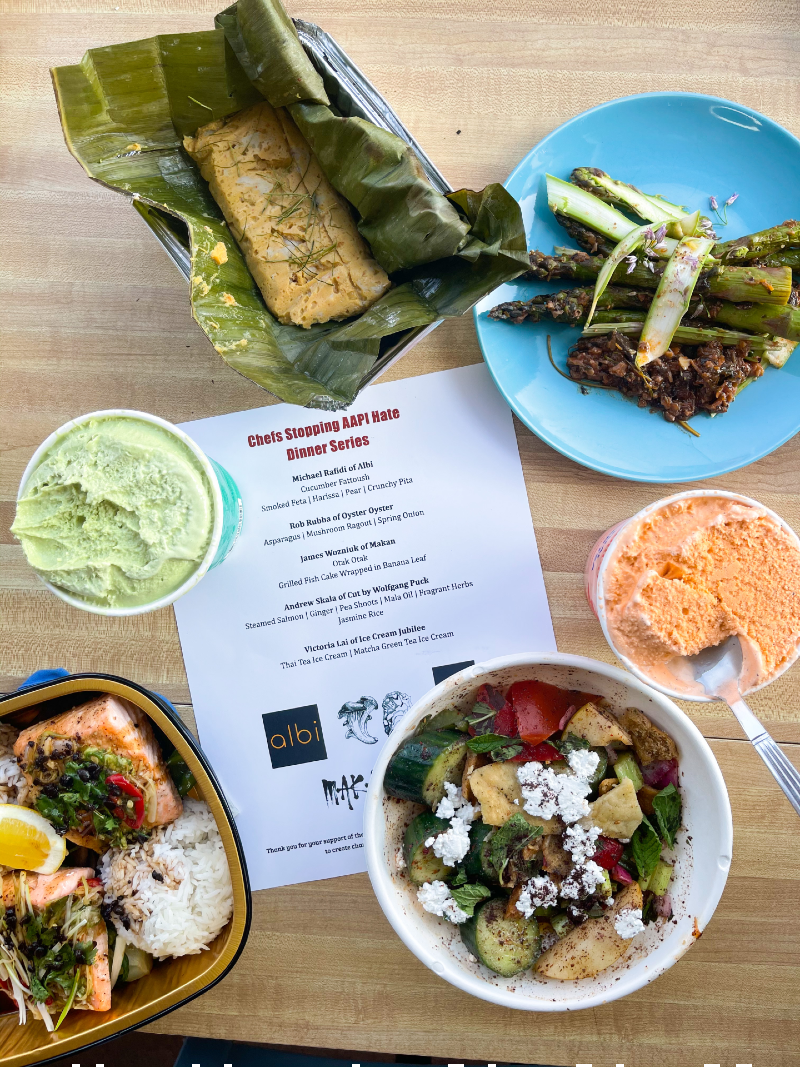
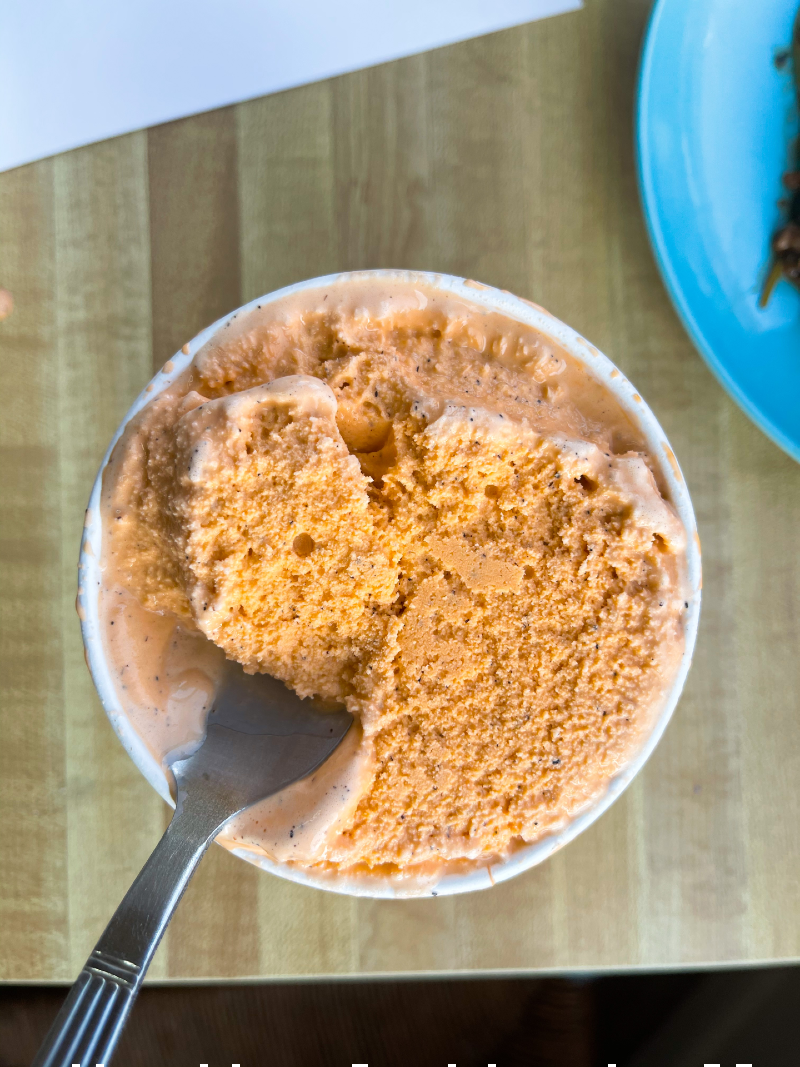
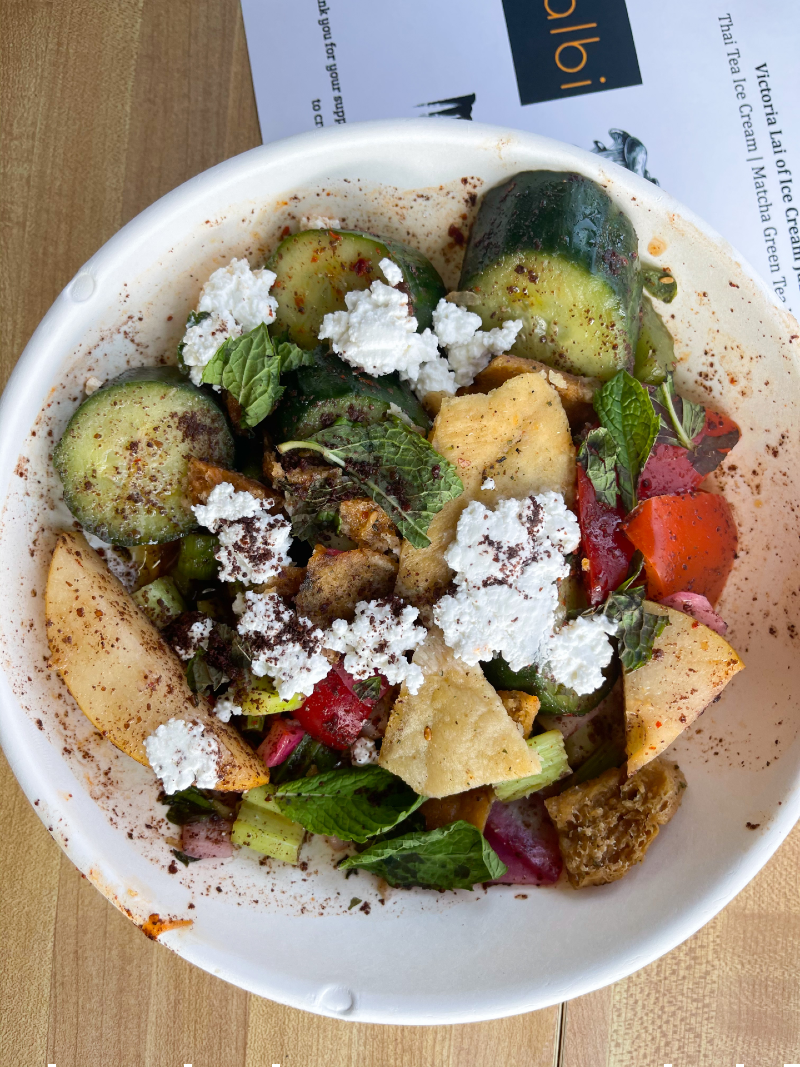
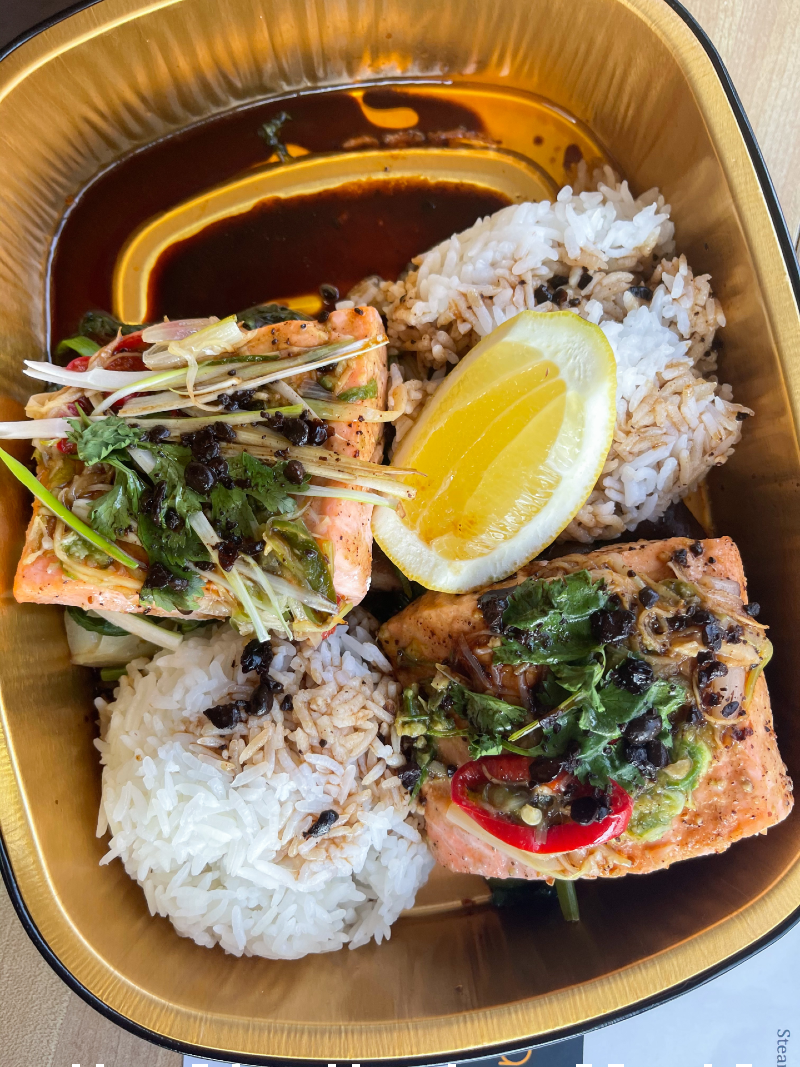
The fish reminded me some of the seafood dishes I had received as part of the Chefs Stopping AAPI Hate dinner on May 23. Tim, while managing to be an award-winning, locally acclaimed chef, owner and manager of several venture, still managed to start a national campaign with his close friend and fellow D.C. chef, Kevin Tien (who I featured last month).
The two decided to collaborate and utilize their cooking skills and platform in D.C., which Tim says gets them people to buy their food and listen to their words, after they started to see the increase in violence against Asian Americans in the U.S. There was a sense they just had to do something, like Tim says, since they had a platform that gave them some sense of responsibility to help educate others on what it has been like to be Asian in America.
That sense then snowballed from a one-time dinner with friends and fellow chefs in D.C. donating their skills to fundraise for organizations combatting hate, to 45 chefs in D.C. signing up for nine more dinners throughout May, to launching a nationwide campaign in San Francisco and New York. Tim says him and Kevin are bullishly driven long-time friends, so when Kevin called for help, Tim said, “F*ck it, let’s do it,” and lended his operations experience to the cause. He said the conversations usually started with Kevin calling like, “Hey man, let’s try this thing,” and Tim would agree, in a groundhog day type cycle.
Both own restaurants and have several full-time jobs, but still launched Chefs Stopping AAPI Hate. Tim was able to devote most of his energy to the campaign during May because Andrew, his partner at Lucky Danger, took over managing the pop-up and he had a great support system that helped give the bandwidth to make Chefs Stopping AAPI Hate successful. He also credits the national team of volunteers that helped set the framework for setting up the initiative nationally.
The campaign has raised over $100,000 to donate to local organizations and has wound down for a pause during the month of June. Tim says that balancing all his businesses and Chefs Stopping AAPI Hate was difficult and alluded it to when times he’s been in service at restaurants when it’s so busy that “you feel like the castle is about to crumble, but you dig yourself out of the hole by putting your head down and getting it done.” So, once the busy month of May wrapped up, Tim took a couple days off to decompress before setting off with the rest of the members of the campaign to reorganize to become a sustainable campaign. One of his biggest fears, which he says has already been seen, is that AAPI Heritage Month will end and attacks will keep going on, but the spotlight will move on. But Chefs Stopping AAPI Hate has put in the application to be an official 501c and more dinners, especially in-person ones, will be coming as the campaign formulates plans for the rest of the year. Keep an eye out for how you can support Tim, Kevin and their team as they take the chance to bring to the forefront the struggles of growing up Asian in America.
A special May edition of TSR highlights Chefs Stopping AAPI Hate for Asian American and Pacific Islander Heritage Month.
Welcome to a super super special edition of The Sunday Roast! I am so proud of this edition and eternally thankful that the DC super star subject took time to be featured. I’m trying out a different format below, so hopefully you enjoy it, and make sure to send me any feedback!
This month: As some of you already know, May is Asian American and Pacific Islander Heritage month. And at a time when violence against Asian Americans is at a terrifying high, it’s important to reflect on how we can uplift, support and protect AAPI voices from any hatred. I’ve seen lots of initiatives launch to respond to the rise in hate crimes, especially here in D.C. One of the more prominent initiatives was full of local food celebrities who took their talents and created a delicious event that then launched into a successful national campaign. You may already know what I’m talking about: Chefs Stopping AAPI Hate. Well, I finally grabbed a ticket to the second-to-last dinner and snagged some of the founder’s time. So keep scrolling to read more about how food was used for good.
You may not know this about the three time James Beard nominee and Food & Wine magazine’s “Best New Chef,” but Kevin Tien actually got his start in the corporate world after getting his Master’s in Statistical Analysis and Business Analytics. However, his love of food eventually trumped any passion for business and he decided to join the culinary world in 2009. He originally hails from Lafayette, Louisiana, so he worked in some restaurants around the state, then in Texas and D.C., before finally opening his own restaurant: Himitsu, which artfully combined Vietnamese, Japanese, Latin American and Southern cuisine. Himitsu earned loads of acclaims, and then three years later, Tien closed up shop to focus on two new ventures: communal venue Emilie’s and chicken sandwich hotspot Hot Lola’s.
And of course, both have earned all sorts of awards and been named “must try” places. Then, last year, some of the top food news was that Tien was leaving Emilies and opening up a new joint to top even his past accolades. In the fall, after a pandemic full of ups and downs, Tien opened up a modern dining room featuring a similarly modern take on Vietnamese cuisine at the InterContinental hotel on The Wharf, which was formerly occupied by the award-winning Kith/Kin.
In the short time that it’s been open, Moon Rabbit has been one of the most popular dining spots in D.C. The 50-seat restaurant’s website says the food: “evokes memory, honors history, references globally inspired techniques and spotlights reinterpreted takes on regional Vietnamese dishes to the vibrant waterfront dining scene. Tien’s menu is intended to be a love-letter to his heritage as a first generation Asian-American, and to showcase dishes that tell his personal story, through an elevated and innovative lens.” It’s also now become the pick-up spot for the Chefs Stopping AAPI Hate! So now, if you’re keeping score, he’s a top-rated chef that has worked at several restaurants, launched and headed a nationwide successful charity, and stars in the latest Food Network Discovery Plus TV show: Chopped Next Generation. Whew.
A Q&A with the founder of Chefs Stopping AAPI Hate.
I know you’ve said that the recent rise in violence towards Asian Americans and Pacific Islanders, especially the shootings in Georgia, played a big role in why you and Tim launched this initiative, but I was wondering, what was the thought process behind using food and your cooking skills for a good cause, or that particular cause?
For Tim and I, we wanted to make a difference and the best way we knew how was through our best skill set, which is cooking. For most people, their fist introduction to someone else’s culture is through food, so we wanted to make that connection.
What about the format/experience you chose — what was your reasoning behind a five-course to-go meal set at that price point?
We chose to do our dinner series to go because it was already what all chefs were used to during the pandemic. You get to have this amazing 5 course meal for two people for the price of $150, which is a great deal, because if you went to the majority of the chefs restaurants, a dinner for two at the end would run about that much.
When it comes to the menus, do you or anyone else curate them to an extent to make sure dishes go together or do the chefs have free rein? When is the menu typically decided by?
We gave the chefs free rein for them to make their own food. Each chef has such a unique story to tell and we wanted them to be able to tell it through their food. And the menu was normally decided at least a week prior to each dinner.
Most menus have a mix of several different cuisines, so similar to the last question, do you try to feature certain types of cuisines on each menu, such as Asian cuisines?
We wanted a balance of meals for each week, but mostly we wanted to make sure the other chefs/restaurants had availability to be a part of Chefs Stopping AAPI Hate. Everyone who participated is so amazing, so it wouldn’t have mattered who was cooking each week as it was all not to be missed!
How did you initially partner with Tim and the other high-profile chefs included in your first dinner, including Erik Bruner Yang, Peter Chang and Yuan Tang? And making that first leap to schedule more dinners past just a one-time occurrence, how did you approach who to reach out to donate their time and skills? Were they old coworkers, friends, other chefs you admire, etc.? It seems a lot of well-loved restaurants in DC are participating and that to an extent that may be driving people to buy tickets.
The first dinner was a call from our friend Kyley who connected the first 5 chefs for the initial dinner. From there, I wanted to do more and just started calling and messaging every chef I knew personally in DC. Our culinary community is very close knit, so reaching out to friends and colleagues was very important to continue raising awareness.
Has there been a trend on the reason why DC chefs have decided to sign up, like to support the cause, use their skills, etc.?
DC chefs have always been so generous with their time & resources and helping everyone when they can. We are here to feed people, and are here to help our communities in any way possible as well.
Will you or Tim Ma cook for one of the dinners again or are both you now settled more into an administrative role?
Tim and I still do both, we currently have a very small team, so we do everything from cooking dinners, to speaking on panels, to printing menus and everything in between. But our team consists of 8 people who help do this in other cities and the many volunteers and partners each week who really make this happen.
I see you’ve now expanded to NYC, Detroit and San Francisco. Are there any other cities on the horizon that you hope to expand to? Are you still managing this endeavor, and how do you envision it to grow?
Our to go series is ending this month, but we are working on a lot of new events and activities through the end of the year. Our next events are going to be in LA and Houston. We want to make sure we are continuing this work past the month of May and to always be constantly working towards a better future.
What drove you to partner with/raise funds for RISE and Stop AAPI Hate?
RISE and Stop AAPI Hate are just a couple of the organizations we are working with. Each city we are working with local organizations as well, for example, in NYC we are working with APEX for Youth and Hearts of Dinner. We wanted to be able to help on all levels locally and nationally.
As for the pick-up aspect, does that raise any challenges or limitations for what you can feature in the menus? Do you ever envision switching these to in-person dinners or doing it as a one-time event, or something along those lines?
We haven’t had any challenges so far and the pick ups have been really seamless. We are hoping to do a few in-person events later on this year.
What’s it been like for you starting a program in DC that has expanded to a national one, getting loads of national attention? How has it felt with the media appearances and spreading awareness?
Honestly it’s been amazing to receive so much support from everyone, our goal is to raise awareness and funds and we have done both. We have to set the intention and we have been focusing on the educational component as well. To be able to create change, you have to know the history of AAPI hate and then we can move forward with change.
DON’T FORGET! It’s your last call to experience this amazing dinner from local celebrity chefs for a great cause. Each ticket feeds two people, and pick-up is between 5-6:30 p.m. at Moon Rabbit. Here’s the menu for May 30:
Kwang Kim of SHŌTŌ chopped cured Atlantic Salmon with shallots, chives, serrano peppers, chili mayo and micro cress, miso brioche bun
Bradley Marlatt of Moon Rabbit 5 spice porchetta, ramp relish and a compressed apple salad
Jong Son of Tiger Fork Mian Bao Xia (shrimp toast) with fermented chili aioli
Amy Brandwein of Centrolina Crab crepe cake, frisée ramp salad
Caitlyn Dysart of Piccolina Coconut Rum Baba rum-soaked savarin, coconut cream, toasted almonds, cherry compote
Soak up the sun with a recipe from a New Orleans native-owned Louisiana style joint in the May edition.
Welcome back to The Sunday Roast! Thank you to all of you who filled out my audience survey. I got some really valuable feedback and I’m grateful. I used a random name generator to pick Rhianna Kern as the lucky winner of the $20 Compass Coffee gift card, which I sent over after. I know she’s excited to get some delicious coffee and I’m excited to see what she gets! I’ll be keeping the survey open for about another month to hopefully get some more responses, but for now, the raffle is closed.
This month: Back in March, I had foolishly reached out to a Louisiana hotspot just before Mardi Gras to ask if they would have time to be featured. Obviously, they were too busy, but we decided to reconnect for a May feature and now here we are! I’m thankful they took the time to circle back and work with me on this month’s edition. I’ve been to this local mainstay a couple times, usually in March around Mardi Gras, and their pastries and cocktails are unbelievable. The recipe they chose to feature, however, is a bit more suited for the nice weather outside and any grill you may have access to fire up.
When Chef David Guas thinks back to his earliest memory of cooking, he thinks about grilling burgers with his father and grandfather. David comes from a family of Cuban descent that took grilling very seriously, so being handed the tongs was a rite of passage. Choosing a recipe that utilized the grill for The Sunday Roast was only natural! What he’s really known for, however, is specifically his master of Louisiana cooking. He cherishes the memories of cooking with his Aunt Boo and learning the fundamentals of a homestyle cooking he’s known for years later, from the roux to the Holy Trinity (celery, onion and bell pepper), which may seem simple, but according to David, they require much patience, finesse and technique.
He soon began his career as a professional cook as a pastry chef at the Windsor Court Hotel in New Orleans under the wing of Jeff Tunks, the executive chef at the time. Jeff then helped begin Passion Food Hospitality in D.C. in 1998, and took David along for the ride. He helped opened several restaurants with the group and began a solo career with his first cookbook, DamGoodSweets: Desserts to Satisfy Your Sweet Tooth New Orleans Style. Then, in 2010, Guas made the leap to open a place of his own, his New Orleans-style eatery, Bayou Bakery, Coffee Bar & Eatery. Both of those major milestones were inspired after Hurricane Katrina erased many of the neighborhoods David had grown up in. When the devastating event brought back memories of his childhood, David’s career shifted to focusing on preserving and recording those memories, most of which revolved around food.
Recipes and traditions from home are what inspire David every day to celebrate the uniqueness of New Orleans. Operating the only New Orleans native-owned Louisiana eatery allows David to share the cuisine that defines his home state and the South, but while using local produce and products from Virginia. NoVa is now what David calls home, so the eatery anchors him to his roots while showing off what his new home has to offer. And now he wants to offer that to others with not only good food but a community gathering place with a sense of belonging.
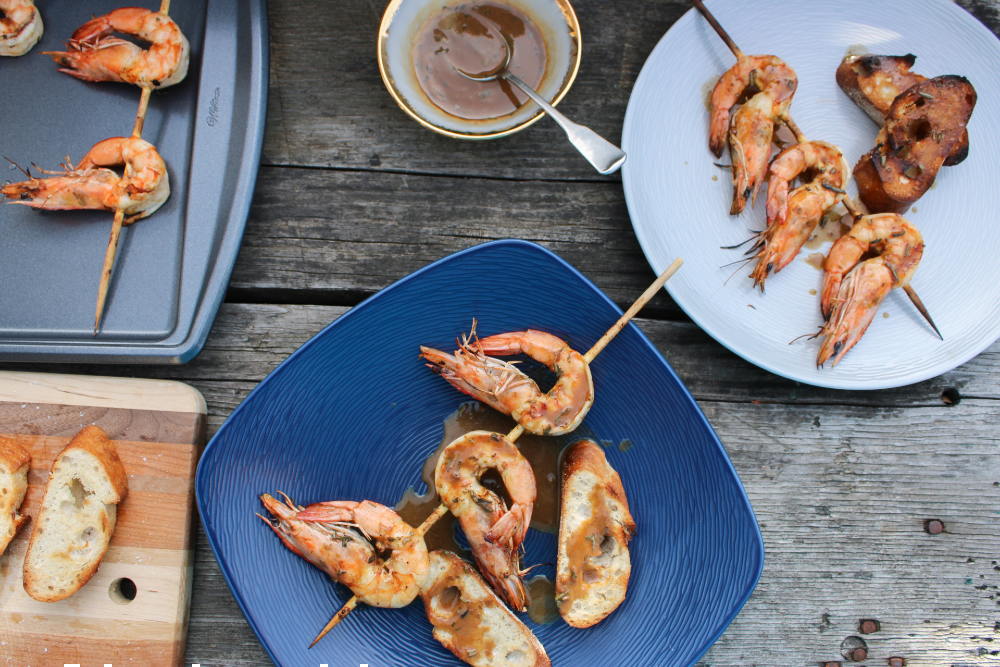
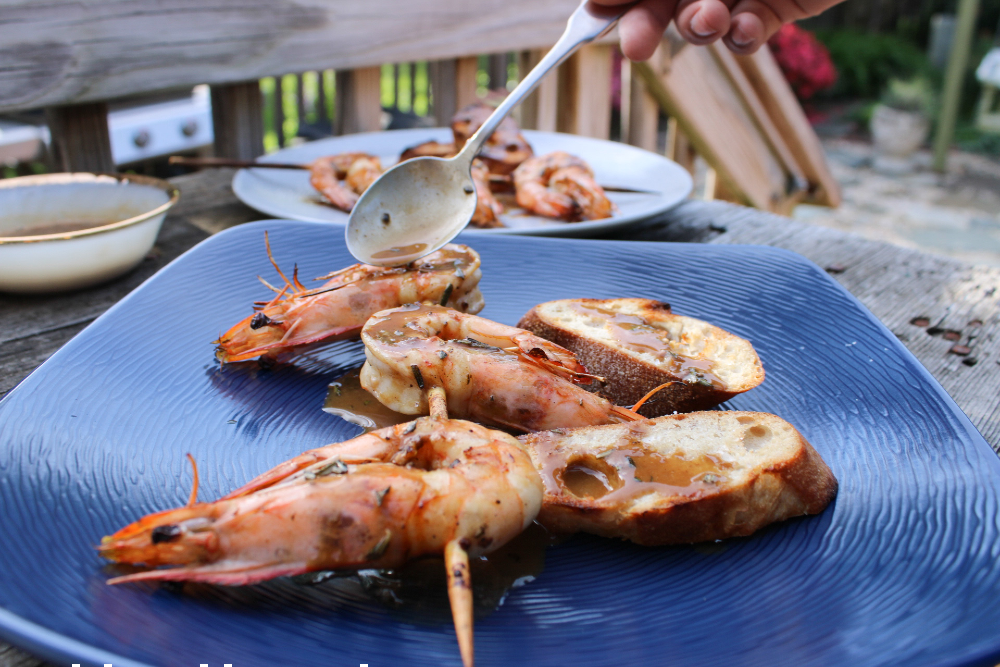
Spooning that buttery sauce aaaaall over everything.
It’s only fitting that David shares a recipe packed with flavors that emit nostalgia and the sense of home. His restaurant speaks to his original home, New Orleans, so that transplants like him can feel right at home.
His menu is a selection of delectable southern sweets and savory eats including pralines, beignets, muffelettas, gumbo, chicory coffee and Abita beer. David brings not only the flavors of New Orleans to the DMV but the spirit of the city, too. Many people know the pockets of neighborhoods that have reached celebrity status, like the French Quarter, but David wants to show off something local, that radiates New Orleans’ charm, in the forgotten corners of the city.
But don’t worry, David still celebrates one of the more famous exports of the city: Mardi Gras. The holiday is typically all about celebrating and gathering with people,
but since this year was different and people could not really gather for the holiday, Bayou Bakery put a twist on its annual extravaganza. Just as they continue to do during the pandemic with loads of to-go options, the eatery’s “krewe” brought the “pardi straight to your door,” as David puts it. The box included a murder mystery game, beads, masks, doubloons, a boa,
hurricane mix and a DIY decorating kit.
What the iconic Arlington mainstay is up to is always an important update, but onto the recipe now.
This recipe comes from another one of David’s cookbooks, Grill Nation: 200 Surefire Recipes, Tips, and Techniques to Grill Like a Pro.
David says the original story behind this recipe started with Chef Pascal Manale of the famous century-old restaurant, Pascal’s Manale. The story goes something like this: a customer came into Bayou Bakery after a trip to Chicago and described the most incredible shrimp dish he had ever tasted.
So David got to work and sautéed some shrimp in garlic, Worcestershire sauce, black pepper and a lot of butter. But, while the man told him it was nothing like the dish in Chicago, this dish is special to David. The smell and taste of this recipe instantly brings him back to his childhood in Aunt Boo’s kitchen in Abbeville, so he’s hoping to share that nostalgia with you.
Fire up the grill and get ready for that sunny weather with some shrimps on the barbie.
Processing…
Success! You're on the list.
Whoops! There was an error and we couldn't process your subscription. Please reload the page and try again.














 The Sunday Roast